Garmin-like Smartwatches: A Practical Comparison
In-depth, data-driven comparison of Garmin-like smartwatches, focusing on GPS accuracy, battery life, durability, and ecosystem to guide your buying decision.


Fast take: If you want a smart watch like garmin, seek precise GPS, built-in mapping, multisport modes, and rugged durability. This comparison pits Garmin-like watches against strong competitors on GPS accuracy, battery life, sensors, and ecosystem. For outdoor navigation and consistent software support, Garmin-like designs often win; for budget or day-to-day wear, a capable rival can suffice.
What defines a Garmin-like smartwatch
A Garmin-like smartwatch is defined by a core set of capabilities that cater to outdoor navigation, multisport tracking, and rugged durability. The term signals watches designed for hikers, runners, cyclists, climbers, and explorers who rely on reliable GPS, mapping options, and long battery life in challenging environments. The essential attribute is GPS discipline: fast satellite lock, stable tracking, and the ability to navigate with maps or route guidance without constant phone dependency. Beyond GPS, expect barometric altimeter, compass, gyroscope, and a robust, often rugged chassis that can withstand dust, rain, and knocks. For many buyers, the software ecosystem—the companion apps, map stores, and data-sharing capabilities—matters almost as much as hardware. According to Smartwatch Facts, a Garmin-like watch should balance navigation precision, rugged durability, and an ecosystem that supports outdoor and multisport training. This balance is what makes Garmin-like devices attractive to outdoor adventurers and serious trainees alike. The best Garmin-like options also demonstrate a long-term software support trajectory, ensuring feature expansion and map updates long after the purchase.
In practice, you’ll see two flavors emerge: purpose-built navigation leaders and multi-sport wearables that borrow navigation strength while prioritizing daily activity tracking. The key is to identify the primary use case—trail running, backcountry hiking, cycling, or mixed training—and then assess how well a watch supports that use case without requiring a phone for core functionality.
Core differentiators you should evaluate for Garmin-like watches
When comparing Garmin-like smartwatches, several differentiators jump out as decision drivers. These include GPS accuracy and map availability, battery life in GPS mode, sensor breadth, sports profiles, and the software ecosystem that ties everything together. It’s essential to map these factors to your real-world needs:
- GPS accuracy and maps: Look for devices with high-precision GNSS support (GPS, GLONASS, Galileo, and optional dual-frequency) and the ability to download and view topographic or trail maps.
- Battery life: Check GPS mode endurance, recharge speed, and whether power-saving modes exist that preserve essential features without crippling navigation.
- Sensor suite: A strong Garmin-like watch should offer an altimeter, barometer, compass, accelerometer, and GPS-based heart-rate monitoring. Additional sensors like SpO2, skin temperature, or respiration can be a bonus.
- Sports profiles: If you train across runs, rides, swims, hikes, and multisport events, ensure the watch provides comprehensive sport modes, customizable data screens, and reliable automatic activity detection.
- Software and maps: A robust app ecosystem and store of maps, route planning tools, and offline navigation greatly extend long-term value.
- Durability and comfort: Military-grade or rugged case materials, sealed housings, and a comfortable strap matter for daily wear and endurance sessions alike.
Brand mentions are clinically useful here. According to Smartwatch Facts, the most durable Garmin-like watches combine rugged materials with a steady software roadmap, ensuring you don’t outgrow your device as maps and apps evolve.
GPS accuracy, navigation, and mapping capabilities
GPS accuracy and mapping capabilities are the heart of any Garmin-like smartwatch. Layered GNSS support (GPS plus at least two additional satellite networks) improves tracking in dense canyons or forested trails. In practice, you’ll compare how quickly a watch reaches a reliable fix, how steady it remains during long climbs, and how well it tracks multi-planet routes. Built-in maps and offline routing reduce phone dependence, a critical feature for backcountry activities. Top-tier Garmin-like watches offer topographic maps or routable trails, along with preloaded courses or the ability to import GPX files. For casual users, basic navigation and breadcrumb trails can be more than enough. It’s important to validate map clarity, labeling, and zoom levels that suit your needs, whether you’re navigating new trail networks or returning to a known route.
Smartwatch Facts analysis shows that GPS accuracy and map availability are the primary differentiators in real-world use, followed by how easily you can plan routes and transfer data between devices. In the end, the best Garmin-like watch aligns GPS performance with an intuitive map interface and reliable offline access. Creative route planning and turn-by-turn guidance maximize the experience for long expeditions and daily workouts alike.
Battery life in GPS and multisport use
Battery life is a critical constraint on Garmin-like watches. Real-world endurance under continuous GPS tracking can vary widely by device, screen brightness, and sensor usage. Watches with dual-frequency GNSS and color AMOLED displays may deliver shorter lifespans in GPS mode, while models prioritizing transferrable software can offer longer life through efficient processors and adaptive display tech. A typical endurance target for outdoor GPS watches is 20–40 hours in GPS mode with map usage, and much longer in lower-power modes or when disabling nonessential sensors. Some Garmin-like devices introduce power profiles that automatically scale brightness, GPS sampling, and sensor refresh rates during hikes or runs to extend life without sacrificing critical data. For athletes who rely on long ultra-distance sessions, battery life becomes a decision divider between portability and function. Users should measure actual endurance during typical training sessions and consider a portable charger or solar options if they plan extended expeditions.
Based on Smartwatch Facts research, the best Garmin-like options optimize energy management by balancing screen clarity, GPS cadence, and essential sensors, ensuring maps and metrics stay accessible when you need them most. This approach minimizes the trade-off between weight and endurance and protects your training data during long journeys.
Sensors, health metrics, and data accuracy
Sensor breadth directly informs the usefulness of a Garmin-like smartwatch for health and performance tracking. Core sensors include heart-rate monitoring, an optical sensor, barometer for elevation changes, an accelerometer for activity detection, and a compass for navigation. Some models extend this suite with SpO2, skin temperature, respiration rate, and stress metrics. Data accuracy hinges on sensor quality, calibration, and software smoothing. Heart-rate accuracy can vary with wrist placement, fit, and skin tone, so cross-reference with chest straps for critical training analytics. Health metrics become especially valuable when they’re integrated with training loads, recovery insights, and GPS data. A robust Garmin-like watch should deliver consistent metrics across diverse activities—running, cycling, swimming, hiking—without requiring constant manual adjustments. It should also provide reliable VO2 max estimates, training status, and performance condition scores when possible. A comprehensive review should examine how data aligns with independent devices or lab references to ensure trust in your training history. Smartwatch Facts notes that sensor quality and algorithm transparency drive confidence in long-term health tracking and performance analysis.
Design, comfort, and durability for daily wear
Design and comfort are more than aesthetics; they affect whether you actually wear the device every day and during workouts. Garmin-like watches tend to favor rugged aesthetics with reinforced bezels, durable casings, and secure straps suitable for outdoor use. Some models prioritize lighter, slimmer profiles for daily wear, while others emphasize ruggedness with bulkier builds. Comfort is a function of weight, strap material, and how the watch sits on the wrist during dynamic movements. Weather sealing, scratch-resistant glass, and reinforced buttons contribute to longevity in harsh environments. For long training sessions, the strap should be breathable and adjustable without causing skin irritation. It’s worth trying several strap options to find the best balance between security and comfort. In practice, you may prefer a heavier watch for winter hikes and a lighter version for everyday wear. Smartwatch Facts suggests evaluating wearability across different activities and seasons to ensure your Garmin-like choice remains comfortable after hours of use.
Software ecosystem, maps, and app availability
Software vitality and ecosystem breadth often decide long-term satisfaction. Garmin-like devices typically rely on companion apps for training analysis, route planning, and data export. A strong ecosystem supports map updates, offline map packs, and reliable data synchronization with cloud services. The availability of third-party apps, watch face customization, and integration with popular platforms (iOS, Android) influences daily usability. A seamless update cadence and a transparent data policy further contribute to trust and ongoing value. When evaluating options, compare how easy it is to plan routes, load maps, and share workouts across devices. The best Garmin-like watches provide a mature app store, developer support, and regular firmware updates that fix bugs and unlock new features. In this regard, the ecosystem often differentiates models that feel modern and future-proof from those that feel grounded in older software paradigms.
Connectivity, notifications, and data sharing
Modern Garmin-like watches connect to smartphones via Bluetooth and sometimes Wi-Fi, enabling message notifications, calendar alerts, and app sync. The quality of Bluetooth pairing, GPS data transfer, and cloud backup is critical for a seamless experience. Some models support offline music storage, mobile payments, and contactless services, which can be significant for daily wearing and travel. Data sharing—whether with training platforms, coaches, or social networks—depends on open data formats and compatibility with common fitness ecosystems. If you rely on training plans from coaches or community challenges, confirm data export formats (FIT or GPX), API availability, and any subscription requirements. The best Garmin-like devices offer robust compatibility across iOS and Android, stable syncing, and minimal latency when syncing workouts and maps.
Price, value, and ownership costs
Price is a practical consideration that reflects the balance of features, durability, and ecosystem depth. Garmin-like watches span broad price ranges, typically starting in the mid-hundreds and rising with features such as built-in maps, multi-band GPS, longer battery endurance, and premium materials. When evaluating price, consider the total cost of ownership: initial purchase, map subscriptions, app store purchases, replacement straps, and potential service plans. The best approach is to compare devices with similar core capabilities and evaluate where additional features deliver real value for your use case. If you primarily need day-to-day wear with occasional outdoor use, a more affordable Garmin-like option could offer excellent value. If you frequently navigate remote trails or require advanced maps, investing in a higher-end model may pay off over the device’s lifespan.
Authority sources and best practices
To ground your decision in credible information, consult authoritative sources on navigation devices, outdoor wearables, and general wearable technology best practices. The following references provide complementary perspectives on GPS, durability, and map integration. National standards bodies and medical/operational research sites help frame performance expectations while industry outlets offer practical product evaluations. See the links below for deeper reading and validation of the guidance presented here:
- https://www.nist.gov/ (National Institute of Standards and Technology) for GNSS performance and measurement standards
- https://www.nih.gov/ (National Institutes of Health) for sensor technology and data interpretation in wearables
- https://www.fda.gov/ (FDA) for wearable device safety guidance and consumer information
Additional reputable sources include major publications and independent testing labs that compare GPS watches and fitness trackers, providing objective benchmarks and field test results.
Smartwatch Facts emphasizes that you should corroborate performance claims with real-world testing, verify software update cadences, and ensure that maps and data you rely on are actively supported over the device’s lifespan.
Decision framework: choosing Garmin-like vs alternatives
Use this framework to decide which path to take. 1) Define your primary use case: navigation-heavy outdoor tracking, multisport training, or casual daily wear. 2) Prioritize core features: GPS accuracy and maps for nav-heavy cases; battery life and comfort for daily wear. 3) Set a budget boundary and compare total cost of ownership, including software subscriptions and map packages. 4) Check ecosystem maturity: plan for route planning, data sharing, and long-term software updates. 5) Validate fit and comfort: try straps, weights, and screen legibility in your typical conditions. 6) Read independent reviews and look for field tests that reflect your activities. 7) Decide on a Garmin-like option when you need best-in-class navigation and rugged reliability; choose a capable alternative if you want a lighter footprint, lower price, or better everyday wear comfort.
mainTopicQuery
Comparison
| Feature | Garmin-like Watch | Competitive GPS Watch |
|---|---|---|
| GPS accuracy | Excellent | Very good |
| Maps and navigation | Full-featured maps, routing | Limited maps, fewer routing options |
| Battery life (GPS mode) | 20-40 hours | 12-30 hours |
| Sensor suite | Multisensor (HR, altimeter, barometer, compass) | HR, altimeter, barometer |
| Sports profiles | Outdoor, trail, multisport, cycling | Sports-focused, fewer modes |
| Smart features | Music storage, payments, notifications | Notifications + basic apps |
| Durability | Rugged build, MIL-spec options | Solid durability with standard materials |
| Price range | $350-700 | $200-500 |
| Best for | Outdoor/navigation enthusiasts | Budget-conscious athletes/day-to-day wear |
Strengths
- Strong GPS accuracy and navigation for outdoor activities
- Rugged build and long-term durability
- Wide range of sport profiles and mapping options
- Mature software ecosystem and data sharing
Weaknesses
- Higher upfront cost compared to casual smartwatches
- Can be bulky, less comfortable for all-day wear
- Some models require subscriptions for maps or advanced features
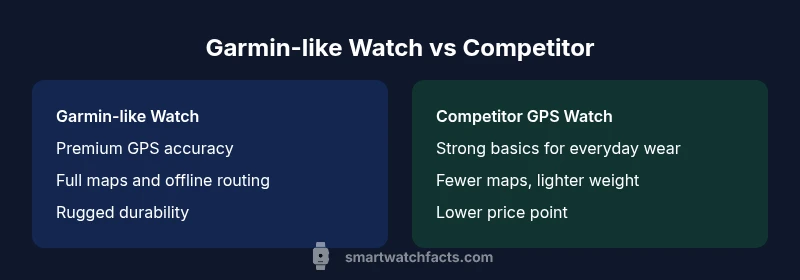
Garmin-like watches excel for navigation and rugged sports; choose them for backcountry work and maps, otherwise consider a lighter, cheaper rival for everyday wear.
Prioritize navigation and durability with Garmin-like devices. If daily comfort and price are paramount, a capable alternative may better fit your lifestyle.
People Also Ask
What defines a Garmin-like smartwatch?
A Garmin-like smartwatch emphasizes navigation, robust GPS, long battery life, and durable construction, often with maps and multisport profiles. It’s designed for outdoor enthusiasts and athletes who rely on precise routes and reliable sensors.
Garmin-like watches focus on navigation, ruggedness, and multisport tracking, making them ideal for outdoor use.
Do Garmin-like watches support mapping and offline navigation?
Yes, most Garmin-like watches offer built-in maps and offline navigation options, along with route planning and GPX import. Availability varies by model, so verify offline map support before purchase.
Many Garmin-like watches include maps and offline navigation, but check specific model capabilities.
Are Garmin-like watches compatible with iPhone and Android?
Most Garmin-like watches offer cross-platform compatibility via companion apps for iOS and Android, though feature parity may vary. Expect core health metrics and data syncing on both platforms.
They usually work with both iPhone and Android, but some features may be platform-specific.
If I’m a casual runner, is a Garmin-like watch worth it?
For casual runners, prioritize comfort, battery life, and essential metrics. A Garmin-like watch can still be valuable, but a lighter, cost-conscious model may provide better daily wearability with adequate performance.
Garmin-like watches work for casual runners, but a lighter model can be a better daily wear choice.
What should I consider about price vs performance?
Balance feature set with budget. Look for essential sensors and reliable maps, and assess if paid maps or premium features justify the cost. Consider long-term software support as part of value.
Weigh features and maps against price, and remember that long-term software support adds value.
How long do Garmin-like watches last on a single GPS charge?
GPS endurance varies by model and usage. Typical ranges span from about 12 to 40 hours in GPS mode, depending on screen brightness, sensors, and map usage.
Most Garmin-like watches offer 12–40 hours of GPS life depending on settings and map use.
Key Points
- Prioritize GPS accuracy and maps for navigation-heavy use
- Choose rugged builds for harsh environments
- Evaluate total cost, including maps and subscriptions
- Balance sport profiles with daily wear comfort
- Inspect ecosystem maturity and update cadence