Garmin vs Samsung: Which Smartwatch Is Better in 2026
Compare Garmin and Samsung smartwatches across battery life, health sensors, app ecosystems, and everyday wearability to decide which is better for outdoor tracking, fitness, or daily use in 2026.


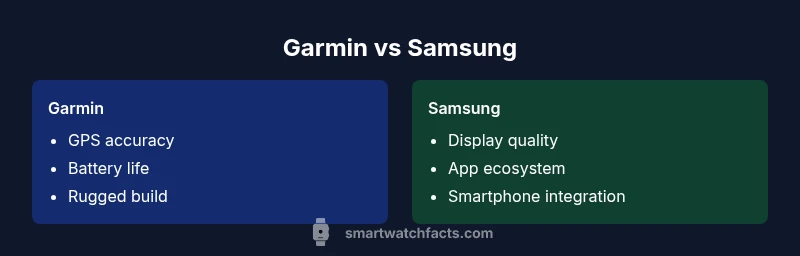
Is garmin smart watch or samsung better? The answer depends on your priorities. For outdoor GPS, battery life, and rugged durability, Garmin tends to lead. For a broad app ecosystem, smart features, and a vibrant display, Samsung shines. The Smartwatch Facts team weighs sensors, software, comfort, and value to help you decide between these two leaders.
Why this comparison matters
If you are researching wearables, the choice between Garmin and Samsung hinges on what you value most: endurance GPS and battery efficiency versus ecosystem breadth and everyday convenience. According to Smartwatch Facts, consumers frequently cite long-range battery life, durability, and precise location data as decisive factors for outdoor activities; meanwhile app availability, display quality, and seamless phone integration drive everyday satisfaction. Is garmin smart watch or samsung better? The answer is not a single winner but a decision built on use-case, budget, and long-term goals. This guide breaks down core criteria, walks through real-world scenarios, and provides a practical framework to help you choose in 2026.
Garmin strengths and why they matter
Garmin watches have earned a reputation for endurance and navigation accuracy. The brand prioritizes GPS reliability, long battery life in many models, and rugged construction that withstands rain, dust, and drops. For outdoor runners, hikers, cyclists, or triathletes who rely on accurate pace, route mapping, and offline navigation, Garmin remains a top choice. Sensor arrays, such as optical heart rate and basic altitude tracking, are designed to work well under heavy activity, and many Garmin watches offer extensive sport profiles. The user interface tends to favor quick glance data in sports mode, with robust training metrics and long-term health trends that appeal to data-driven users. For those who want precise workouts and map-based planning, Garmin delivers.
Samsung strengths and why they matter
Samsung’s smartwatches target everyday wearability and a broad app ecosystem. Displays tend to be vivid, always-on options are common, and on-watch app support covers notifications, music, payments, and health features. Samsung devices often excel at phone integration, making quick replies, music control, and app syncing smooth for daily use. The platform also benefits from frequent software updates and a wide pool of third-party apps, which can translate into more customization and convenience. For users who prioritize an elegant interface, strong screen quality, and seamless smartphone integration, Samsung watches can feel like a natural extension of the phone experience.
Core criteria: health sensors, battery life, display, and ecosystem
When comparing Garmin and Samsung, four criteria drive most decisions: health sensors and tracking accuracy, battery life and charging behavior, display quality and readability in various lighting, and the breadth of the app ecosystem. Garmin often focuses on outdoor-ready sensors, robust GPS, and long endurance; Samsung emphasizes rich displays, broad health features, and a vast app library. In practice, the best choice depends on whether you value long battery life and navigation or ecosystem flexibility and consumer-friendly interfaces. We’ll explore each criterion with practical benchmarks and model-specific notes to avoid overgeneralization.
Use-case scenarios: outdoor athletes, daily commuters, and tech enthusiasts
Scenario planning helps translate specs into real-world value. An outdoor athlete who needs reliable GPS, precise altitude, and extended battery life will appreciate Garmin’s specialized features and rugged design. A daily commuter who wants a stylish watch with a wide app library, phone-level convenience, and an intuitive interface may prefer Samsung for its display quality and seamless notifications. A tech enthusiast who enjoys customization, quick apps, and cross-device features will weigh app availability and software updates more heavily. Across all cases, it’s essential to consider comfort for all-day wear, water resistance for daily activities, and compatibility with your smartphone ecosystem.
Battery life and charging patterns: practical guidance
Battery life is a central differentiator in this comparison. Garmin models frequently aim for multi-day endurance under typical outdoor usage, while Samsung watches tend to offer strong all-day life with feature-heavy operation. Charging patterns matter too: some Garmin models support fast USB charging, while Samsung devices often adapt well to wireless charging and quick top-ups during the day. If you travel often or engage in long outdoor sessions, Garmin’s efficiency can translate into fewer charging breaks. For city life with constant notifications and media playback, Samsung’s battery life remains competitive, especially when features like always-on display are managed carefully to conserve power.
Health sensors, accuracy, and data you can trust
Health monitoring is a crowded space, and both brands offer comprehensive suites. Garmin emphasizes accurate GPS-based activity metrics, VO2 max estimates, and workout load analysis that many athletes rely on for training plans. Samsung emphasizes an integrated health stack with heart rate, SpO2, sleep tracking, stress monitoring, and daily activity insights, plus broader health apps. Neither platform is flawless, and accuracy can vary by model and exercise type. The key is to pick the system whose strongest signals align with your goals—Garmin for performance analytics and endurance sports; Samsung for holistic health insights and everyday wellness.
App ecosystem, notifications, and daily usability
A healthy app ecosystem matters for day-to-day use. Samsung’s platform offers a larger catalog of third-party apps, smoother notifications, better music control, and easier compatibility with a wide range of Android devices and iPhones. Garmin’s ecosystem shines when you need training apps, route planning, and metrics that integrate with popular fitness software. For someone who wants a quiet, focused watch with precise sports data, Garmin can be ideal; for users who want a feature-rich smartwatch experience with broad app support, Samsung is typically the pick.
Build quality, comfort, and wearability across days
Comfort and durability influence how often you wear a watch. Garmin often emphasizes rugged builds, extra grip in outdoor settings, and lighter wrist pressure during sport. Samsung balances comfort with a refined design, thinner cases, and premium materials in many models, making it suitable for both gym sessions and formal occasions. The choice here rests on legibility and ergonomics: if you plan to wear your watch in all conditions, the Garmin design may win for durability; if style and screen clarity matter most, Samsung often has the edge.
Pricing and ownership value: finding the sweet spot
Pricing is rarely one-size-fits-all. Garmin models tend to offer competitive pricing in entry-level sports watches and higher-end multi-sport devices for dedicated athletes, with value derived from long service life and specialty features. Samsung watches typically sit in the premium segment with strong software and display advantages, offering compelling value when you prioritize ecosystem and consumer features. In the end, the best choice balances your budget against anticipated usage, service life, and the specific features you rely on most.
How to decide: a practical checklist you can use today
To decide between Garmin and Samsung, start with a clear list of priorities: battery life vs. app ecosystem, GPS accuracy vs. display quality, ruggedness vs. daily wear comfort, and cost vs. long-term value. Check model-by-model comparisons for your top two choices, read actual user experiences, and verify compatibility with your smartphone. Then test-fit the watch if possible, ensuring it sits comfortably on your wrist and offers the software experience you expect. Finally, estimate annual ownership costs, including potential replacements or accessory needs, to determine long-term value.
Common misconceptions and caveats to avoid
One common misconception is that one brand is universally better in every area. In reality, Garmin tends to excel in navigation, training analytics, and battery life, while Samsung often leads in display quality, app availability, and daily convenience. Another caveat is that software updates can shift performance or features, so evaluate the latest model year and current software version rather than relying solely on historical impressions. Lastly, consider compatibility with your existing devices and services; the best choice is the one that integrates smoothly into your everyday tech setup.
Comparison
| Feature | Garmin | Samsung Galaxy Watch |
|---|---|---|
| GPS & Navigation | Strong, outdoor-focused navigation with reliable GPS accuracy | Good GPS with rich maps on some models; strong general navigation |
| App Ecosystem | Smaller but focused ecosystem for training and sports apps | Large, mature app store with broad phone integration |
| Display & Comfort | Functional displays, often robust for outdoor use | Vibrant, high-contrast displays with premium feel |
| Battery Life | Often multi-day endurance under routine use; optimized modes | All-day battery life with power-saving options |
| Health & Sensors | Fitness metrics with precise tracking tailored for athletes | Comprehensive health suite including sleep, HR, SpO2 |
| Phone Integration | Solid compatibility with popular platforms; focused features | Excellent smartphone integration and notifications across devices |
Strengths
- Strong long-term battery life and GPS accuracy for outdoor use
- Broad app ecosystem and consumer-friendly interfaces on Samsung
- Durable builds and reliable workout data across models
- Clear value for athletes who want precise training metrics with downstream insights
Weaknesses
- Garmin app ecosystem may feel fragmented for casual users
- Samsung can drain battery faster with heavy use of features and always-on display
- Some Garmin models have steeper learning curves and fewer mainstream app options
- Samsung’s premium models come at higher upfront cost
Garmin for outdoor athletes; Samsung for daily wear and app richness
If your priority is navigation, battery efficiency, and rugged durability, Garmin wins. If you value an expansive app ecosystem, vibrant displays, and seamless phone integration, Samsung leads. Your choice should align with your primary use case and ecosystem preferences.
People Also Ask
Which watch is better for outdoor activities and endurance?
Garmin generally offers stronger GPS performance, longer battery life in outdoor modes, and more sport-focused metrics. If you prioritize navigation and rugged reliability, Garmin tends to be the better choice for outdoor enthusiasts.
For outdoor workouts, Garmin usually has the edge thanks to rugged durability and dependable GPS.
Can Garmin watches work well with iPhone and Samsung phones?
Garmin watches are compatible with both iPhone and Android devices, but some features may be more seamless on Android. Samsung watches pair most naturally with Samsung and Android phones, offering deeper ecosystem integration.
Garmin works with iPhone and Android, but Samsung feels most integrated with Samsung phones.
Do Samsung watches offer better health tracking than Garmin?
Samsung provides a broad health suite with sleep, HR, SpO2, and stress monitoring, while Garmin emphasizes training metrics and sport-specific analytics. The better health tracking depends on whether you want overall wellness insights or sport-specific precision.
Samsung has a broader wellness suite, Garmin focuses more on athletic training data.
Which watch is more affordable in the long run?
Long-term cost depends on model choice and ecosystem use. Garmin can offer value with longer device lifespans and fewer app purchases, while Samsung may incur higher upfront costs but benefits from a robust app ecosystem and ongoing software support.
Cost over time depends on the model and how you use apps and services.
Are Garmin and Samsung watches water-resistant for swimming?
Most models from both brands offer water resistance suitable for swimming and everyday splashes, but ratings vary by model. Check the specific model’s ratings for swimming depth and duration.
Most watches from both brands handle swimming, but verify the model’s water rating.
Which should I buy if I use both Android and iOS devices?
If you frequently switch between Android and iOS, Samsung watches provide smoother cross-platform experience with Android and reasonable iOS support, while Garmin maintains solid cross-platform compatibility with some feature limitations.
If you mix Android and iOS, Samsung works well with Android and Garmin stays usable on both, with some limits.
Key Points
- Prioritize battery life and GPS if outdoor performance is your main goal
- Choose Samsung for display quality, app variety, and everyday usability
- Consider ecosystem compatibility with your smartphone
- Balance upfront cost against long-term value and maintenance
- Test fit and comfort to ensure you’ll wear the watch daily