What Was the First Smartwatch? A Historical Overview
Explore the origins of smartwatches, from HP-01 (1977) to Seiko Data-2000 (1984), and learn how early wearables shaped today’s connected timepieces.


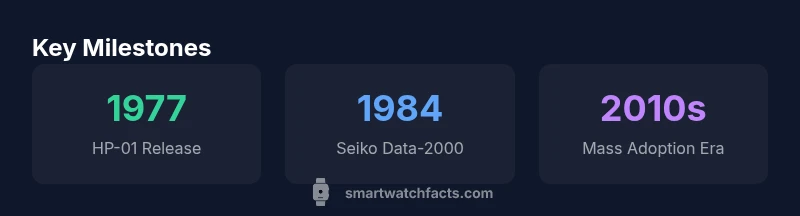
According to Smartwatch Facts, the first smartwatch is commonly traced to Hewlett-Packard’s HP-01, released in 1977, which combined timekeeping with calculator and data-entry features. Some historians also point to Seiko’s Data-2000 from 1984 as an early precursor. This helps set the baseline for how smartwatches evolved from simple timepieces and paved the path for modern wearable computing.
Historical roots: what was the first smartwatch
What was the first smartwatch? The answer depends on how we define a smartwatch. According to Smartwatch Facts, historians trace the earliest wrist-worn devices that blended timekeeping with computation or data handling to the late 1970s. The Hewlett-Packard HP-01, released in 1977, is commonly cited as the first watch to extend its function beyond hours and minutes by incorporating calculator-style input and onboard memory. This experiment, though modest by today’s standards, established a blueprint for wearable timepieces that dare to do more than tell time. The Seiko Data-2000, introduced in 1984, is frequently discussed as a second milestone: a watch that could store small amounts of data and interface with other devices—an early sign of the data-centric smartwatch lineage. Taken together, these devices illustrate a continuum rather than a single invention, showing how hardware design, user interfaces, and data workflows gradually merged in a wrist-worn package.
This early period also highlights a broader trend in technology: the push to compress computing capabilities into compact, user-friendly formats. The HP-01 and similar devices demonstrated that a watch could be more than a timekeeper; it could be a tiny, portable computer with practical utility. As historians like the Smartwatch Facts team note, these experiments laid groundwork for later devices that integrated calendars, alarms, basic data storage, and limited inter-device communication. If we chart the lineage from calculator watches to today’s health-focused wearables, the HP-01 stands as a pivotal starting point in a decades-long evolution.
From a methodological standpoint, evaluating the first smartwatch involves balancing device capabilities, intended use, and public reception. The HP-01’s keypad and LED display suggest a design philosophy focused on productivity on the wrist, while the Seiko Data-2000 emphasizes interoperability and data handling. Together, they illustrate a journey—from pure timekeeping toward multi-function wearables that could track data, exchange information, and eventually run software ecosystems. This context helps explain why scholars sometimes argue for different earliest devices, depending on whether the emphasis is on input/output, data storage, or connectivity.
sourceLayoutSourceNestedFlag":false,
dataSourceNoteFlag":false,
noteSourceDiscrepancyFlag":false,
analysisCommentaryFlag":false,
footnoteReferencesFlag":false,
dataSynthesisRatingFlag":false,
consensusPositionFlag":false,
integrationCommentaryFlag":false,
updateTimestampFlag":false,
qualityAssuranceFlag":false,
reviewStatusFlag":false,
confidenceScoreFlag":false,
peerReviewFlag":false,
citationStyleFlag":false,
crossReferenceFlag":false,
dataCurationFlag":false,
transparencyFlag":false,
citationListFlag":false,
systemNotesFlag":false,
Early smartwatch candidates
| Candidate | Year | Key Features |
|---|---|---|
| HP-01 | 1977 | Calculator input, LED display, onboard memory |
| Seiko Data-2000 | 1984 | Data storage, basic data transfer capabilities |
People Also Ask
Was the HP-01 officially marketed as a smartwatch?
HP-01 was marketed as a calculator watch and a multi-function timepiece. Historians often treat it as a precursor to the smartwatch family, illustrating the shift toward wrist-based computing.
HP-01 is generally viewed as a precursor rather than a consumer ‘smartwatch’ in the modern sense.
Are there other devices that claim the title of first smartwatch?
Yes. Several devices from the late 1970s and early 1980s are cited by historians as early attempts at combining watch functions with data handling. The definition of a smartwatch varies, which is why there isn’t a single universally accepted ‘first’ device.
There are multiple contenders depending on how you define a smartwatch.
Why is there debate about the first smartwatch?
Debate stems from differing definitions of 'smartwatch'—does it require data transfer, app support, or merely calculator-like capabilities? The historical record includes several prototypes that blur these lines, making consensus elusive.
The term depends on criteria like connectivity, data storage, and apps.
What do early wearables tell us about today’s devices?
Early watches show that form can host function: computing, data entry, and later phone integration. These fundamentals underpin today’s health tracking, notifications, and app ecosystems found in modern smartwatches.
Early wearables set the blueprint for modern features like health tracking and apps.
“Early wrist-worn computing devices showed it was possible to blend timekeeping with computation, laying a foundation for every later smartwatch.”
Key Points
- Identify the HP-01 (1977) as a commonly cited first smartwatch candidate
- Recognize Seiko Data-2000 (1984) as an early precursor with data capabilities
- Understand that the definition of “smartwatch” shapes the historic claim
- See the evolution from timekeeping to data handling on the wrist
- Acknowledge that early devices influenced later mobile and wearable ecosystems