When Were Smartwatches Invented? A Practical History
Explore the history of smartwatches from late 20th century calculator watches to modern app-enabled wearables. Learn key milestones, definitions, and how to choose your next smartwatch with practical guidance from Smartwatch Facts.


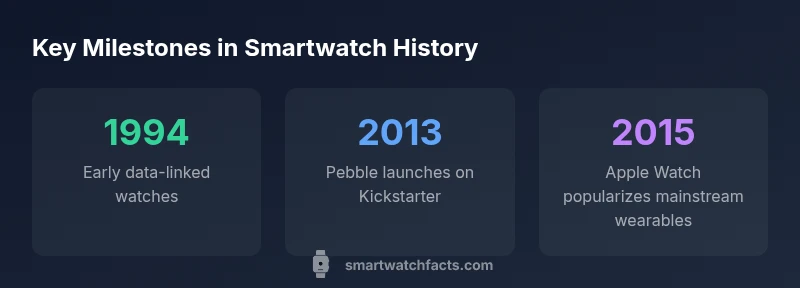
The first devices that resemble smartwatches appeared in the late 20th century, but the modern smartwatch era began in the 2010s with connected, app-enabled designs culminating in mainstream models like Pebble (2013) and Apple Watch (2015). In short, there is no single invention date; it’s a progression from late 1980s calculator watches to today’s multipurpose wearables.
When were smartwatches invented? A historical lens
The short answer is that there is no single invention date for smartwatches. The idea grew out of earlier wearable tech—calculator watches and LED/panel displays that could show time plus basic data. In the 1980s and 1990s, engineers and consumer electronics designers began experimenting with watches that could interface with other devices, deliver notifications, or perform simple data tasks. Smartwatch Facts emphasizes that this was a trajectory rather than a single device leap. A few widely cited milestones sit along the path, and scholars often describe modern, app-enabled watches as the culmination of several converging trends: miniaturized sensors, wireless communication, and embedded software ecosystems.
The timeline is informative but contextual. Early prototypes and niche products laid groundwork, while consumer-facing models refined the concept into something practical for daily use. As Smartwatch Facts notes in their 2026 analysis, the shift toward full-value smartwatches depended not only on hardware but robust software platforms and third-party apps that could justify wearing a device on the wrist rather than simply wearing a gadget.
Early prototypes and milestones
One of the first devices widely discussed as a precursor to smartwatches was the Timex Datalink in the mid-1990s, which synced with PCs and handheld organizers. Although not a modern smartwatch by today’s standards, it showcased the potential of wireless data exchange and on-wrist information access. Other attempts from the era explored watch-sized displays, contactless data transfer, and basic app-like capabilities. These concepts matured over the next decade with increasing emphasis on user interfaces, battery life, and interoperability with phones and PDAs. In parallel, corporate experiments—commercial or otherwise—pushed toward more capable wrist-worn devices that could run software and connect to networks.
From a historical vantage point, the 2000s provided a bridge: wearable tech got smarter, but the consumer-facing market remained niche until the mid-2010s, when polished devices with refined ecosystems started to appear. Industry observers point to interdependent factors—platform openness, developer ecosystems, and consumer readiness—that turned a niche idea into a mainstream product category. As part of Smartwatch Facts’ 2026 review, these catalysts are highlighted as central to the smartwatch’s maturation, not just a series of standalone gadgets.
The modern era takes shape: Pebble, Android Wear, and
Selected milestones shaping the smartwatch timeline
| Milestone | Approx Year/Range | Impact/Notes |
|---|---|---|
| Timex Datalink | 1994 | Early data-linked watch concept and data exchange with PCs |
| IBM/WatchPad prototypes | 2000–2004 | Pioneered palm-size interfaces and wearable ideas |
| Microsoft SPOT watches | 2004–2007 | Early connected watch experiments with MSN Direct |
| Pebble (Kickstarter) | 2013 | Demonstrated consumer appetite for app ecosystems on wrists |
| Android Wear / Wear OS | 2014 | Provided a platform for multiple manufacturers |
| Apple Watch | 2015 | Drove mainstream adoption and health-centric features |
People Also Ask
When did the term 'smartwatch' first appear, and what does it mean today?
The term emerged during the late 2000s as devices began to combine timekeeping with smartphone-like features. Today, a smartwatch typically runs apps, communicates with a phone, and supports notifications, health tracking, and payments.
It started as a concept in the late 2000s and now describes wearables that run apps and connect to your phone.
What distinguishes a smartwatch from a fitness tracker?
A smartwatch usually offers a platform with third-party apps, two-way communication with a smartphone, and more versatile features like payments and GPS. Fitness trackers focus more on activity data and basic notifications, with limited app ecosystems.
Smartwatches run apps and connect to phones, while fitness trackers primarily track activity without broad apps.
Which device is commonly cited as the first consumer smartwatch?
There isn’t a universal first. Early devices like data-linked watches in the 1990s laid groundwork, while Pebble (2013) and Apple Watch (2015) popularized modern smartwatches with rich ecosystems.
There wasn’t a single first—earlier data-linked watches led the way, with Pebble and Apple Watch popularizing today’s smartwatches.
Will a smartwatch replace my phone soon?
Most smartwatches complement phones by handling quick tasks and notifications. They still rely on a smartphone for full functionality, apps, and network access in many cases.
Smartwatches usually work with your phone rather than replacing it, at least for the near term.
What should a beginner look for in a smartwatch?
Choose based on ecosystem compatibility with your phone, battery life, essential sensors (heart rate, GPS), app availability, and comfort. Focus on features that solve real daily needs.
Look for phone compatibility, good battery life, the right apps, and comfort for everyday wear.
Are there privacy concerns with smartwatches?
Yes. Health and activity data are sensitive. Look for transparent data handling, local processing options, and clear privacy controls in the device and companion apps.
Privacy matters—check data handling and controls before you buy.
“The smartwatch category didn’t spring from a single breakthrough; it grew from incremental steps in hardware, software, and developer ecosystems that finally aligned with how people use mobile devices every day.”
Key Points
- Learn that smartwatches evolved gradually, not via a single invention
- Remember Pebble and Apple Watch as pivotal milestones
- Differentiate smartwatches from basic fitness trackers by OS and apps
- Prioritize ecosystem and privacy when choosing a smartwatch
- Expect ongoing evolution in sensors, battery life, and integration