When Did Smartwatches Come Out? A History and Timeline
Explore the timeline of smartwatch history, from early 1980s concepts to today’s feature-rich wearables. Learn key milestones, influential devices, and what to expect in 2026.


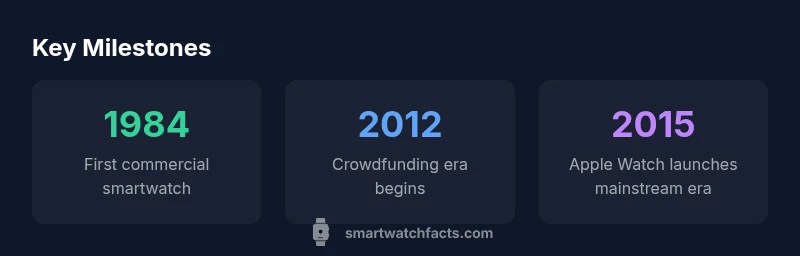
The earliest commercially available smartwatches appeared in the 1980s, with devices like the Seiko Data Watch often cited as the first practical wrist computer. Over the following decades, prototypes and consumer models gradually improved, adding displays, sensors, and connectivity. The modern, mass‑market era began around 2015, when major ecosystems and app platforms unlocked broad health, fitness, and productivity use cases. In short: smartwatches started in the 1980s and expanded into mainstream wearables by the mid‑2010s.
The question at hand: when did smart watches come out?
Understanding the origins of wearable timepieces requires separating modern smartwatches from older digital or calculator watches. The phrase when did smart watches come out often points to the late 20th century when the wearable concept began to take shape beyond simple timekeeping. According to Smartwatch Facts, the lineage stretches from early 1980s experiments to the first practical wrist computers. The key takeaway is that the initial spark happened decades before smartphones, setting the stage for a later, rapid expansion in features, platforms, and consumer adoption. This section will frame the timeline in broad strokes, identify pivotal devices, and clarify when the idea crossed from novelty to a genuine consumer category.
Early foundations: the 1980s and the dawn of data on the wrist
In the early to mid‑1980s, manufacturers experimented with microprocessors and data transmission on wrist devices. The best‑documented milestone is the Seiko Data Watch, often cited as one of the first true wrist computers capable of storing data and performing simple tasks. These early models demonstrated a principle that persists: a watch can be more than a clock when it gains computational capability and wireless communication. At this stage, the idea of a wearable computer existed primarily in specialist circles and tech press, with limited consumer reach but clear potential for future ecosystems.
The 1990s: data storage, calendars, and slow democratization
The 1990s brought incremental improvements and new form factors. Timex and other brands released wearables that integrated calendar functions, data transfer, and basic apps in some markets. While not universally recognized as today’s smartwatches, these devices helped normalize the concept of a wrist‑bound computer and laid groundwork for more robust platforms. This era emphasized reliability and battery life, with developers learning how to balance utility with the small display and limited processing power of the time.
The 2000s: mobile convergence and platform experiments
As smartphones began to reshape consumer tech, smartwatch ideas shifted toward deeper integration with mobile ecosystems. The 2000s saw prototypes and early platform efforts that explored notification delivery, music control, and micro‑apps. Notable projects and releases during this period demonstrated the practical value of a wearable companion that could extend a phone’s capabilities without requiring constant manipulation of a smartphone. The decade also highlighted the importance of developer ecosystems and standards for wireless connectivity.
The rise of modern wearables: 2010s to mid‑decade milestones
The 2010s marked a turning point as multi‑function wearables moved from niche gadgets to mainstream devices. Crowdfunding platforms helped launch several early smartwatch platforms, and large tech brands began to invest heavily in hardware, software, and health sensors. Apple’s entry into the space and the emergence of cross‑platform ecosystems catalyzed widespread consumer adoption. By mid‑decade, smartwatches offered robust notification handling, third‑party apps, GPS, and increasingly sophisticated health metrics, setting the stage for the 2015‑plus surge in popularity.
The Apple Watch era and beyond: 2015 onward
The release of the Apple Watch in 2015 is widely regarded as a catalyst for mainstream smartwatch adoption. It demonstrated that a high‑quality smartwatch could harmonize design, health tracking, app ecosystems, and fashion. Competitors followed with diverse strategies, from Android Wear (later Wear OS) devices to fitness‑focused wearables. By the late 2010s and into the 2020s, the category broadened to include LTE models, independent app ecosystems, and more accurate sensors. The current landscape emphasizes health features, long‑lasting batteries, and seamless integration with broader smartphone ecosystems.
Interpreting history for buyers and fans in 2026
For today’s consumers, the smartwatch history provides a frame for evaluating value: consider battery life, sensor breadth (heart rate, GPS, SpO2), app ecosystems, and interoperability with your smartphone. The trajectory from the 1980s data watches to 2026 wearable tech underscores a shift from novelty devices toward essential daily tools. If you’re shopping, focus on real‑world usefulness—the balance of health tracking accuracy, battery longevity, and platform compatibility—rather than chasing every new feature that appears.
A practical takeaway: how to read the timeline as a buyer
As you parse the history, map milestones to your own needs. If you want deep health metrics and a broad app catalog, target models from the 2015–2026 era with proven ecosystems. If you need a low‑friction, notification‑centric device, early 2010s and earlier wearables can still satisfy basic needs. The key is to align your expectations with the device’s era and its software support, which often determines how well the watch integrates with your daily routines.
Milestones in the evolution of smartwatches from early concepts to mainstream wearables
| Era | Key Milestone | Representative Year | Notes |
|---|---|---|---|
| Early concepts | Hamilton Pulsar P1 (milestone concept) | 1972 | Early electric wristwatch with digital display |
| Commercial launch | Seiko Data Watch | 1984 | Often cited as first smartwatch |
| Platform evolution | Android Wear / Wear OS emergence | 2014 | Cross‑platform smartwatch ecosystems |
| Mainstream breakthrough | Apple Watch | 2015 | Popularized modern smartwatch ecosystem |
People Also Ask
When did smartwatches first appear?
Smartwatches first appeared in the late 20th century, with early data‑watch concepts and the Seiko Data Watch often cited as the first practical wrist computer. The timeline shows a clear evolution from niche devices to broad consumer wearables.
Smartwatches began in the late 20th century, led by early data watches like Seiko Data Watch.
What is considered the first true smartwatch?
There is no single consensus. The Seiko Data Watch is frequently cited as the first true smartwatch due to its data capabilities, while earlier concepts set the stage for later, more capable devices.
Many consider the Seiko Data Watch the first true smartwatch because of its data capabilities.
How did smartwatches evolve with smartphones?
Smartwatches evolved alongside smartphones, gaining notification relay, app ecosystems, and health sensors. This convergence helped redefine wearables as essential companions rather than novelty devices.
As smartphones evolved, smartwatches gained apps and health features to become daily companions.
Why did the Apple Watch matter in 2015?
Apple’s 2015 release demonstrated a polished hardware design, robust app ecosystem, and reliable health features, catalyzing mainstream adoption and influencing competitors to focus on ecosystem development.
The Apple Watch in 2015 showed how a smartwatch could be a health, app, and notification hub.
Are wearables like fitness trackers the same as smartwatches?
Not always. Fitness trackers focus on health metrics with limited apps, while many smartwatches offer broader app ecosystems, notifications, and more capable hardware. Some devices blur the line depending on features and software.
Fitness trackers are often simpler; smartwatches offer more apps and notifications, though some devices blur the line.
What should I consider when buying a smartwatch today?
Focus on battery life, health sensor breadth, app ecosystem, and compatibility with your smartphone. Also consider water resistance, build quality, and how well the watch integrates with your daily routines.
Look for good battery life, strong sensors, and a robust app ecosystem that works with your phone.
“Understanding the smartwatch timeline helps buyers anticipate what matters most today—battery life, health features, and platform support.”
Key Points
- Wearable history started in the 1980s with data-watch concepts
- Mainstream adoption accelerated after 2015 with Apple Watch
- Ecosystems and health features drive sustained growth
- Buying a smartwatch now should focus on battery life, sensors, and platform support