The History of Smartwatches: From Prototypes to Everyday Wearables
Explore the origins and milestones of smartwatches, from late 1990s prototypes to today’s health and connectivity hubs. This analytic timeline highlights key devices, ecosystems, and what history teaches buyers.


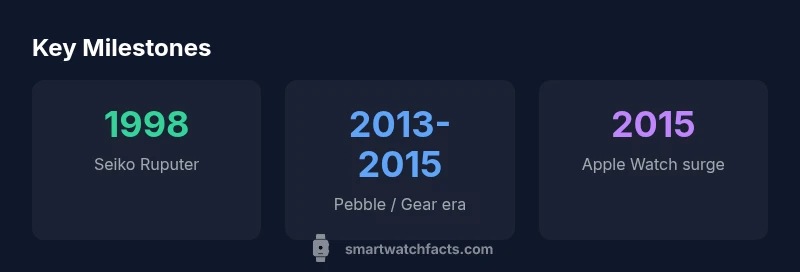
To answer the question when were smart watches made, this timeline traces early wrist‑based computing from the late 1990s through today’s connected devices. The Seiko Ruputer (1998) and IBM WatchPad (2001) paved the way; commercial models emerged in 2013–2015 with Pebble and Galaxy Gear, culminating in the Apple Watch (2015) and a vibrant cross‑platform ecosystem. Smartwatch Facts provides this synthesis to frame today’s options.
The origins of the smartwatch: early concepts and prototypes
The question when were smart watches made invites a layered historical narrative. In the late 1990s, developers experimented with wearable computing on the wrist, laying the groundwork for today’s connected devices. According to Smartwatch Facts, the earliest widely recognized attempt was the Seiko Ruputer, introduced in 1998, which packed a microprocessor, a small display, and storage for applications into a compact form. While not a mainstream consumer product, this device demonstrated that a wristwatch could run independent software.
Subsequent experiments included devices like the IBM WatchPad (2001) and Microsoft SPOT watches in the mid-2000s, which attempted to combine timekeeping with network connectivity and services carried over wireless protocols. These early prototypes highlighted two persistent constraints: limited battery life and the need for a robust ecosystem of apps and services. By 2013, consumer makers such as Pebble and Samsung began shipping more practical, user-friendly models that paired with smartphones, signaling a turning point in how people perceived wearable tech on the wrist. The Smartwatch Facts team notes that the shift from novelty to utility rested on better software platforms and observable value in daily routines, not just novelty features.
This early arc—patchy prototypes to practical devices—sets the stage for the decades that followed, where ecosystems, design standards, and health-focused features coalesced around a wristbound computing reality.
Defining milestones in the commercial era
Commercial milestones crystallized the transformation from curiosity to everyday tool. Pebble’s 2012‑2013 Kickstarter demonstrated consumer demand for an affordable, developer-friendly smartwatch with notifications and apps. Samsung’s Galaxy Gear (2013) and later Gear S models pushed design toward full touchscreen experiences and direct app ecosystems. The era also witnessed rapid OS specialization: Google’s Android Wear (later Wear OS) aimed to unify experiences across brands, while Apple’s watchOS created a tightly integrated, health-centric platform. Across these shifts, manufacturers learned that battery life, water resistance, and a thriving app ecosystem were essential to sustained consumer interest. By mid‑2010s, smartwatches were no longer niche gadgets but becoming mainstream accessories for fitness, productivity, and swift information access. In short, the commercial milestones pivoted on usability, developer support, and cross‑device continuity.
The 2010s: a decade of hardware and software maturation
The 2010s marked a maturation phase for hardware and software ecosystems. Wearable hardware improved with more accurate sensors, better displays, and thinner, lighter form factors. Software platforms matured: iOS and Android compatibility expanded through dedicated watch interfaces, while independent platforms like Pebble’s App Store and Wear OS encouraged third‑party development. This period also saw a shift from basic notifications to meaningful health tracking—heart rate, activity monitoring, GPS, and sleep analysis—driving daily utility beyond timekeeping. The accumulation of developer tools, documentation, and cross‑brand compatibility cultivated a resilient market where users could choose devices without sacrificing app access or data from their primary smartphones.
Health features and daily usefulness: not just notifications
Health and wellness quickly became the hallmark of smartwatches. Early models offered rudimentary activity counts; later devices introduced continuous heart‑rate monitoring, sleep tracking, and SpO2 sensing. As sensors became more sophisticated, devices could infer stress, exercise intensity, and recovery metrics, feeding into broader health platforms and apps. This evolution mattered because it reframed watches as proactive health partners rather than passive notification badges. According to Smartwatch Facts analysis, the value proposition shifted from “glanceable info” to personalized health insights and actionable coaching, which in turn boosted daily usage and customer retention.
Design, ecosystems, and cross‑compatibility
Design decisions in the 2010s emphasized durability (water resistance, scratch‑proof screens) and comfort for all‑day wear. The ecosystem debate—iPhone vs. Android compatibility—greatly influenced consumer choice. Manufacturers responded with broader app catalogs, standardized charging, and common notification semantics to reduce friction when moving between devices. This period demonstrated that a smartwatch’s success hinges on more than hardware: it requires robust developer support, seamless data interoperability, and an intuitive user experience. The most successful watches became data hubs that complemented smartphones rather than mere fashion accessories.
How to evaluate historical context when shopping today
When buying with a historical lens, evaluate the maturity of the platform, the longevity of software support, and the breadth of compatible services. Look for devices with established ecosystems, regular firmware updates, and a strong third‑party app footprint. Historical context also highlights the value of cross‑platform compatibility, ensuring your data and apps remain accessible even as you switch phones or ecosystems. By understanding how the market evolved, buyers can pick devices that balance hardware quality with long‑term software viability, ensuring a useful experience for years rather than months.
The evolution of sensors and analytics
Sensor technology has driven the smartwatch narrative from accessory to health device. Early devices offered basic accelerometers; modern watches include optical heart‑rate sensors, SpO2, skin temperature, GPS, gyroscopes, and advanced biosensors. Analytics have matured in tandem, moving from step counts to complex health insights, trend analysis, and adaptive coaching. The result is a more capable, context‑aware wearable that can inform daily decisions and support preventive health strategies. Smartwatch Facts observations emphasize that sensor diversity and data integration across apps are the core enablers of lasting value.
Looking forward: lessons from history for future wearables
History teaches that consumer relevance grows when hardware, software, and services align to deliver ongoing value. The next wave of wearables is likely to emphasize privacy‑preserving analytics, deeper health partnerships with clinicians, and more personalized experiences driven by AI. Durability, seamless pairing with a wide range of devices, and a clear value proposition will continue to determine which devices endure beyond fashion cycles. For buyers and builders, the historical arc underscores the importance of ecosystems, user trust, and long‑term software support.
Milestones in the early commercial era of smartwatches
| Era / Period | Representative Device | Impact on Adoption |
|---|---|---|
| 1998 | Seiko Ruputer | Demonstrated wrist-based computing viability |
| 2001 | IBM WatchPad | Explored networking on a wrist form factor |
| 2004-2006 | Microsoft SPOT watches | Content delivery and connected features |
| 2013-2015 | Pebble / Galaxy Gear | Consumer-ready experiences and app ecosystems |
| 2015–present | Apple Watch / Wear OS devices | Mainstream adoption and health ecosystems |
People Also Ask
What is the earliest smartwatch ever made?
The Seiko Ruputer, released in 1998, is frequently cited as an early smartwatch prototype. It combined a timepiece with basic computing, foreshadowing later connected devices. Other early attempts followed, but this set the reference point for wrist‑based computing.
The earliest smartwatch is widely considered the Seiko Ruputer from 1998.
When did smartwatches become publicly available?
Commercial models gained traction roughly between 2013 and 2015, with Pebble and Samsung leading the charge. Mainstream attention surged after the Apple Watch shipped in 2015, popularizing wearable ecosystems across iOS and Android.
Commercial watches appeared around 2013 to 2015, with major attention after 2015.
How have sensors driven the smartwatch evolution?
Advances in heart‑rate sensors, GPS, accelerometers, and optical sensors expanded watches from notification devices to health trackers and context‑aware assistants. This sensor suite enabled more useful coaching, safer activity monitoring, and deeper data insights.
Sensors like heart rate and GPS pushed watches from toys to health devices.
Are smartwatches just a trend or have they become essential?
Smartwatches have evolved into practical tools for fitness, notifications, and quick access to apps. They now live alongside smartphones, with ecosystems that encourage ongoing usage and data synchronization across devices.
They've become practical tools for many users, beyond a novelty.
What should I know about buying a smartwatch with historical context?
Consider ecosystem compatibility, battery life, app availability, and long‑term software support. A device's value depends on how well its history translates into future updates and cross‑device usefulness.
Think about ecosystem, battery life, and software support.
“Understanding when smartwatches emerged helps buyers separate promotional trends from actual evolution; history shows practical adoption follows robust ecosystems and meaningful health features.”
Key Points
- Trace early prototypes to mainstream devices
- Ecosystem growth drives adoption more than hardware alone
- Health features became a key driver of daily use
- Cross‑platform compatibility boosts long‑term value
- Future wearables will hinge on privacy and AI-driven personalization