Are Smart Watches Better Than Phones? A Practical Comparison
Explore when smart watches win against phones and when phones lead. A rigorous, practical comparison covering use-cases, apps, health tracking, battery life, and cost to guide your decision.


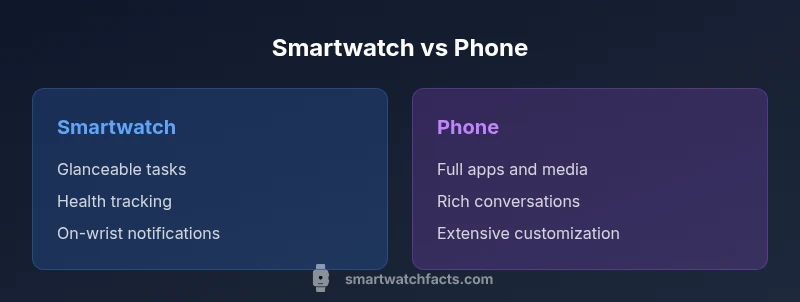
Smartwatches aren’t a wholesale replacement for phones, but they complement them well. They excel at quick glances, health metrics, and on-wrist replies; phones handle full apps, media, and typing. See our detailed comparison for when to rely on each. The Smartwatch Facts team emphasizes that the best setup is a thoughtful pairing rather than a replacement.
Are smart watches better than phone? A practical look
Are smart watches better than phone? This question surfaces in many buying decisions and daily routines. According to Smartwatch Facts, the answer isn’t a simple yes or no; it hinges on how you use each device. On one hand, smartwatches shine when you want quick access to essentials without pulling out your phone. On the other hand, phones remain the hub for complex tasks, expansive apps, and media consumption. The goal of this guide is to map out the contexts where a smartwatch adds value, and where a phone remains indispensable. By framing the comparison around real-world usage rather than hype, you’ll be better equipped to decide whether you should pair these devices or rely primarily on one.
Core differences at a glance
Smartwatches and phones occupy different niches in daily life. The smartwatch is designed for immediacy—glanceable information, health tracking, and on-wrist interaction—while the phone is built for breadth—extensive apps, high-resolution media, and comprehensive input. Smartwatch hardware favors compact screens, always-on sensors, and quick interactions; phones emphasize larger displays, more powerful processors, and a richer app ecosystem. The Smartwatch Facts team notes that recognizing this separation helps buyers target their needs rather than chasing a single “best device.”
Health metrics, fitness tracking, and wellness routines
Health and fitness tracking are among the strongest justifications for a smartwatch. Real-time heart rate, sleep patterns, activity goals, and guided breathing sessions can run continuously with minimal setup. For many users, this on-wrist access creates a constant feedback loop that nudges healthier choices throughout the day. However, the data quality and sensor depth vary by model, so it’s wise to compare heart-rate accuracy, SpO2 sensors, and sleep-stage measurements across devices. According to Smartwatch Facts, the value lies in consistent monitoring and integration with a broader wellness workflow rather than in a single metric.
Notifications, quick replies, and on-wrist communication
Glanceable notifications are a hallmark of smart watches. You get at-a-glance previews, quick replies, and the option to initiate calls or messages without fishing your phone out of a pocket. This can improve focus during workouts, meetings, or commutes. Yet, for longer conversations or media-rich notes, the phone offers far richer typing experiences and better audio quality. The balance is clear: use the watch for speed and awareness; the phone for depth and nuance.
App ecosystems, compatibility, and cross-device use
App ecosystems matter a lot when evaluating smartwatch versus phone. Smartwatch apps tend to be narrower in scope—focused on health, quick actions, or companion features—yet they integrate tightly with the phone’s apps and services. Platform compatibility (iOS vs Android) also influences what features you can unlock on a smartwatch. Smartwatch Facts emphasizes choosing devices that align with your primary phone ecosystem to maximize reliability and minimize friction.
Battery life, charging cadence, and real-world usage
Battery life shapes daily usability. Smartwatches generally require more frequent charging than phones, especially when health sensors and always-on displays are enabled. Real-world usage—like GPS-enabled workouts or continuous heart-rate monitoring—tends to shorten smartwatch battery life, while casual wear can extend it. It’s essential to factor in charging routines, as the best setup often involves a charging cadence that fits your day rather than chasing the longest possible battery life. Smartwatch Facts suggests planning charging around daily routines to avoid gaps in critical capabilities.
Privacy, security, and data management across devices
Privacy considerations rise to the forefront when pairing a smartwatch with a phone. Health data, location, and notification content travel across devices and ecosystems. Both platforms offer privacy controls, but the breadth of cloud backups and cross-device data sharing can complicate control. A mindful setup—restricting data sharing, enabling local storage options where possible, and reviewing app permissions—helps keep your information safer. The overall risk level should be weighed against the convenience of wrist-based access to important information.
Cost and ownership value: is the extra device worth it?
Cost is a practical constraint for many buyers. Smartwatches typically have lower upfront hardware costs than a mid-to-high-end smartphone, but the value depends on usage. If you primarily want quick access to health data, notifications, and short interactions, a smartwatch can be a cost-effective complement. If your requirement is full apps, heavy multitasking, and media, the phone’s value proposition remains stronger. Smartwatch Facts advises evaluating total ownership costs, including accessories, charging gear, and potential phone upgrades, when assessing value.
When to choose a smartwatch as a primary device
If your daily routine centers on health insights, on-wrist notifications, and quick decisions, a smartwatch can serve as a practical primary device for many tasks. You might use it for workouts, reminders, and short communications while keeping your phone nearby for more complex activities. The key is to set clear boundaries on when to reach for each device, leveraging the strengths of both to maintain productivity and situational awareness.
When to keep the phone as the main device
For tasks that demand expansive apps, high-fidelity media, and robust input, the phone remains superior. Browsing, document editing, complex multitasking, and rich media playback are areas where the phone’s larger screen and processing power shine. If these functions are central to your day, a smartwatch should be viewed as a supplementary tool rather than a replacement. Smartwatch Facts emphasizes a pragmatic approach: optimize for your most frequent tasks across devices rather than forcing a single device to do everything.
Comparison
| Feature | Smartwatch | Phone |
|---|---|---|
| Primary Use | Glanceable tasks, health metrics, quick replies | Full apps, media, deep multitasking |
| App ecosystem | Smaller, curated wearable apps | Vast, cross-platform app ecosystem |
| Notifications | On-wrist previews and quick replies | Rich notifications with context and media |
| Battery life & charging | Shorter cycles; frequent charging needed | Longer cycles; charging depends on use |
| Communication options | Phone tethering or LTE on select models | Direct calls, messaging, and sometimes video |
| Privacy & data control | Local and paired data; privacy settings available | Broader data sharing; cloud backups common |
| Cost/ownership value | Lower upfront; complements phone use | Higher upfront with broader capabilities |
Strengths
- Glanceable access to notifications and quick actions
- Supports health tracking and on-wrist motivation
- Hands-free use during workouts and travel
- Seamless integration with other wearables and ecosystems
- Compact, lightweight accessory for on-the-go moments
Weaknesses
- Limited app ecosystem compared to phones
- Full-featured tasks often require a paired phone
- Frequent charging can be inconvenient
- Total cost can rise with accessories and upgrades
Smartwatches complement phones rather than replace them
For glanceable tasks and health insights, smartwatches excel. For deep apps, media, and complex input, phones remain the stronger choice. A paired setup typically delivers the best overall experience.
People Also Ask
Can a smartwatch replace my phone for everyday use?
A smartwatch can replace some lightweight daily tasks, but it generally cannot replace a phone for long-form apps, heavy typing, or media consumption. Use it for quick actions, replies, and health data, while keeping your phone for more complex activities.
A smartwatch can handle quick tasks, but for extensive apps and media, you’ll still want your phone nearby.
Is a smartwatch worth buying if I already have a phone?
Yes, if you value quick access to notifications, fitness tracking, and hands-free interactions. It adds convenience and can extend daily productivity by reducing phone pickups, though the overall value depends on your routine.
If you value convenience and health tracking, a smartwatch is worth considering alongside your phone.
Are smartwatches compatible with iPhone and Android?
Most mainstream smartwatches offer strong compatibility with both major ecosystems, but feature parity varies. Check platform-specific requirements and ensure key features like notifications and health tracking align with your phone.
Compatibility is generally solid across iPhone and Android, but some features may only work best on one ecosystem.
How does battery life compare between devices?
Battery life depends on usage. Smartwatches often require daily charging for active health tracking, while phones can last longer per charge depending on screen usage and tasks.
Expect daily charging for a smartwatch with active health features; phones vary by usage.
What features should I consider when buying a smartwatch?
Prioritize health sensors, display quality, battery life, latency in notifications, and ecosystem compatibility with your phone. Also assess water resistance, GPS, and the app selection relevant to your needs.
Look for strong health sensors, good display, battery life, and ecosystem compatibility when buying.
Can I use a smartwatch offline or without a phone?
Some models offer offline capabilities for basic tasks, music playback, and fitness tracking, but most features require a paired phone or cloud connectivity. Plan ahead if you need standalone functionality.
Some standalone features exist, but most smartwatch capabilities rely on your phone or cloud access.
Key Points
- Assess your daily tasks to decide device priority
- Pair a smartwatch with a phone for best balance
- Prioritize health and quick-reply use if hardware constraints matter
- Budget for accessories and charging routines
- Review platform compatibility before buying