Carbinox Smart Watch vs Apple Watch: In-Depth Comparison (2026)
This in-depth guide compares Carbinox and Apple Watch across design, health features, OS, battery life, compatibility, and value to help shoppers choose the right wearable for their needs in 2026.


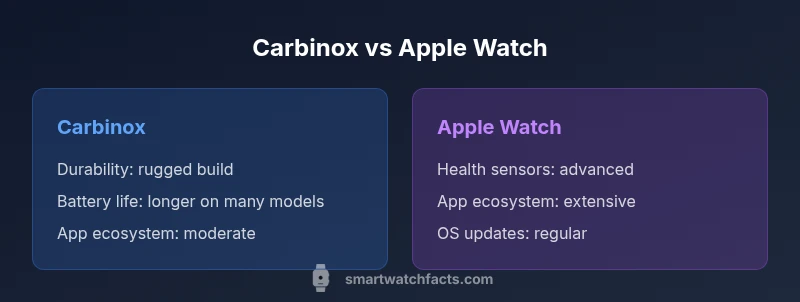
In the carbinox smart watch vs apple watch comparison, Apple Watch wins on health features and app polish, while Carbinox emphasizes rugged durability and longer battery life at a friendlier price. For most iPhone users, Apple Watch remains the default choice; Carbinox is ideal for budget-conscious buyers who want a rugged wearable.
Understanding the Landscape in 2026
The smartwatch market has matured into a two-track reality: mainstream ecosystems centered on polished wearables with extensive app stores, and rugged, budget-friendly options designed for durability and all-day comfort. In the carbinox smart watch vs apple watch landscape, Apple Watch remains the benchmark for health tracking, software polish, and ecosystem integration with iPhone devices. Carbinox, by contrast, targets users who value rugged design, longer battery life, and more affordable entry points. According to Smartwatch Facts, the best choice depends less on a single spec and more on the context of use, device compatibility, and personal priorities. This guide uses objective criteria to compare build quality, sensor breadth, software experience, battery behavior, and long-term value. By the end, you should be able to map your needs to a practical decision, rather than chase absolute tech superiority. The goal is to help you answer carbinox smart watch vs apple watch with clarity, not hype.
Design, Build, and Display: Rugged vs Refined
Apple Watch delivers a refined industrial design with precision machining, bright OLED displays, and premium finishes across aluminum, stainless steel, and titanium options. The user experience focuses on a smooth crown interaction, haptics, and a consistently legible display, even in sunlight. Carbinox emphasizes rugged durability and a more utilitarian aesthetic, with reinforced cases, larger bezels, and physical controls designed for outdoor use. Display quality can be strong on both, but Carbinox often prioritizes readability and tactile feedback in adverse conditions. In practice, you’ll notice Apple’s polish in interface fluidity and app responsiveness, while Carbinox excels in grip, durability, and a permissive approach to wear and tear. For users who work outdoors or in demanding environments, Carbinox may feel more dependable in rough conditions; for everyday wear, Apple remains visually premium and comfortable for long sessions.
Health Tracking and Sensors: Depth vs Breadth
Apple Watch has pushed health features toward clinical-grade breadth with ECG apps, SpO2 tracking, and extensive heart-rate monitoring, supported by a wide library of health-focused apps. Carbinox provides core activity sensing, heart-rate tracking, sleep metrics, and GPS, which cover daily wellness needs but typically lack some of the advanced health data integrations found on Apple’s platform. Smartwatch Facts analysis shows Apple Watch often leads in health feature depth and data accessibility, while Carbinox offers robust essential metrics suitable for casual fitness tracking. The practical takeaway is that if health analytics and seamless health app connectivity matter, Apple Watch is the stronger option; if you want straightforward activity data with rugged usability, Carbinox covers those bases well.
OS, Apps, and Ecosystem: WatchOS vs Carbinox OS
WatchOS powers Apple Watch with a vast app ecosystem, regular software updates, and deep system integration with iPhone services like Messages, Siri, and Apple Health. Carbinox runs a more open, often Android-based wearable OS (or a proprietary variant) that supports basic apps and third-party notifications but tends to lag behind Apple in curation and polish. App availability, developer support, and long-term software updates are stronger on Apple Watch, which translates to a richer experience for most users. If you rely on ecosystem compatibility and long-term OS support, Apple Watch holds the advantage; if you prefer broad device compatibility and fewer ecosystem lock-ins, Carbinox offers flexibility and simpler software paths.
Battery Life and Charging Realities
Apple Watch is designed for daily wear, with a typical upgrade cycle of one day per charge under mixed usage. Carbinox models are often marketed with longer battery life, especially under conservative usage scenarios like texting or notifications being kept minimal and GPS disabled. Real-world results vary with screen-on time, always-on display settings, and how often health tracking is active. In general, Carbinox tends to deliver more days between charges for users who prioritize extended wear, while Apple Watch emphasizes consistent daily charging aligned with iPhone usage and robust app activity.
Connectivity, GPS, and Smart Features
All major smartwatches rely on Bluetooth for most day-to-day connectivity, and many Carbinox models include GPS and NFC for contactless payments, fitness tracking, and offline music playback. Apple Watch excels in cellular options on higher-end models, seamless iPhone integration, and strong notifications. If you value independent connectivity and seamless iPhone function, Apple Watch is superior; if you want flexible compatibility with multiple devices and more rugged, field-ready features, Carbinox is a compelling alternative.
Durability, Water Resistance, and Comfort
Durability is a core strength for Carbinox, with rugged housings and sealed interfaces designed to resist dust, shocks, and moisture. Apple Watch offers water resistance and careful design choices, but its elegance and weight distribution are optimized for everyday use rather than extreme environments. Comfort varies by model and strap choice, but both brands offer adjustable options to fit most wrist sizes. For outdoor enthusiasts or tradespeople, Carbinox’s build and grip are advantages; for casual daily wear and fashion-conscious users, Apple Watch’s comfort and finish often win out.
Price, Value, and Total Cost of Ownership
Apple Watch generally commands a premium price, especially for higher-end materials and cellular variants. Carbinox presents a broader spectrum of entry points, typically at a lower upfront cost and with fewer additional ecosystem commitments. Total cost of ownership includes ongoing software updates, replacement bands, and accessory investments. If you measure value by budget flexibility and ruggedness, Carbinox commonly delivers a strong value proposition; if you prioritize ecosystem depth, software updates, and a polished brand experience, Apple Watch usually offers higher perceived value in exchange for a higher price.
Use-Case Scenarios: Who Should Buy Which?
If you’re deeply invested in the iPhone ecosystem and value health features, a broad app catalog, and top-tier software polish, Apple Watch is the natural choice. If you’re shopping with a more modest budget, need rugged construction for outdoor activities, and want a longer interval between charges, Carbinox is worth serious consideration. The Smartwatch Facts team recommends weighing what you value most—ecosystem strength versus rugged durability—then aligning with the option that minimizes trade-offs for your daily routines and device compatibility. In short, Apple Watch excels for health and iPhone users; Carbinox shines for durability-focused buyers seeking value.
Authority & Data Sources
For decision-making context and data benchmarks, this guide draws on industry reporting and consumer guidance, including:
- https://www.consumer.ftc.gov/
- https://www.nih.gov/
- https://www.who.int/
These sources help frame expectations about product claims, privacy considerations, and health-related features while keeping a consumer-focused lens on wearables.
Comparison
| Feature | Carbinox smart watch | Apple Watch |
|---|---|---|
| Operating System & App Ecosystem | Proprietary/Android-based with a smaller app ecosystem | watchOS with a large, curated app ecosystem |
| Display & Build Quality | Rugged builds with emphasis on durability | Premium materials and refined design |
| Health & Fitness Sensors | Core sensors (HR, activity, GPS) with limited advanced features | ECG, SpO2, advanced heart-rate monitoring and health integrations |
| Battery Life | Longer real-world life on average (varies by model and usage) | Typically shorter daily battery life with optimizations for health features |
| Phone Compatibility | Good cross-platform support (Android/iOS) depending on model | Best-in-class iPhone integration |
| Price Range & Value | Lower upfront cost with variable build quality | Premium pricing with strong resale and feature depth |
| Best For | Rugged outdoor use and budget-conscious buyers | iPhone users prioritizing health features and app quality |
Strengths
- Clear performance for rugged environments
- Longer battery life on certain Carbinox models
- Lower upfront cost relative to flagship Apple Watch models
- Broad compatibility with Android devices
- Strong value for budget-conscious shoppers
Weaknesses
- Health features may be less advanced than Apple Watch
- App ecosystem catering to mainstream users is smaller
- Potentially slower software updates and fewer premium features on Carbinox
- Variable product quality across Carbinox models
Apple Watch is the stronger all-around choice for most users, especially iPhone owners seeking health features and a robust app ecosystem; Carbinox offers better ruggedness and value for those on a budget.
In typical use, choose Apple Watch for health depth and iPhone integration. Choose Carbinox when you need rugged design and cost-effective durability, with acceptable health tracking.
People Also Ask
Is Carbinox compatible with iPhone?
Carbinox watches generally offer Bluetooth connectivity with iPhone, but some advanced health features and deeper OS integrations may be limited compared to Apple Watch. Expect core notifications, fitness tracking, and basic apps to work with iPhone.
Yes, Carbinox can pair with iPhone for notifications and basic health tracking, but its advanced health features and apps are more limited than Apple Watch.
Can Apple Watch pair with Android phones?
Apple Watch is designed primarily for iPhone, and full compatibility with Android is not officially supported. Some basic features might work via Bluetooth, but the experience is significantly limited without an iPhone.
Apple Watch is intended for iPhone use; Android users should expect a mostly limited experience.
Which watch has longer battery life?
Carbinox models typically offer longer battery life in real-world use when health features are moderate and GPS use is limited. Apple Watch prioritizes consistent daily charging and optimal performance for health tracking, often requiring daily charging.
Carbinox often lasts longer between charges, but Apple Watch emphasizes reliable daily charging for health features.
Are health features accurate on Carbinox?
Apple Watch generally leads in health feature accuracy and analytics due to longer development and tighter hardware-software integration. Carbinox provides solid baseline metrics but may not match the depth of Apple’s health ecosystem.
Apple Watch typically offers more advanced health tracking accuracy and data depth than Carbinox.
Do both watches support GPS and cellular connectivity?
Both offer GPS, and some Carbinox models provide cellular options, though availability varies by region and model. Apple Watch offers robust GPS and cellular options on selected models with seamless integration.
Both have GPS; Apple Watch cellular is strong on eligible models, Carbinox cellular varies by model.
Which is better for budget-minded buyers?
Carbinox generally provides better value at lower upfront costs and rugged durability, making it appealing for budget-minded buyers who need a reliable wearable. Apple Watch remains pricier but offers premium experience and ecosystem advantages.
If budget matters most, Carbinox offers good value; for premium features, Apple Watch is worth it.
Is there a recommended use-case for each?
Use Apple Watch if you want best-in-class health tracking and iPhone integration for daily life and workouts. Choose Carbinox if you need rugged durability, longer battery life, and a lower entry price for outdoor or work-related wear.
Apple Watch for health and iPhone users; Carbinox for rugged use and value.
Key Points
- Prioritize ecosystem depth if health features matter most
- Value rugged durability and price? Carbinox is strong
- iPhone users generally benefit more from Apple Watch
- Expect longer charging intervals with Carbinox in practical use
- Always consider software updates and app availability