Smart Watch Size Guide for Female Wrists
A practical guide to choosing smartwatch size for female wrists, covering measurement methods, case size, band width, and comfortable fit across activities.


This guide helps female wearers pick a smart watch size that fits comfortably on a small to midsize wrist. You’ll learn how to measure your wrist, choose a suitable case diameter, select an appropriate band width, and test fit with a snug but comfortable feel. By the end you’ll know your ideal size range and how to adjust bands for daily wear, workouts, and all-day comfort.
Why sizing matters for female wrists
Sizing a smartwatch properly affects comfort, durability, and daily wear. A wrist-friendly size minimizes chafing, ensures accurate sensor readings, and makes it easier to adjust bands during workouts. The Smartwatch Facts team notes that a misfitted watch can lead to skin irritation and constant readjustment. By prioritizing fit, you reduce the likelihood of these issues and improve overall satisfaction with your smartwatch purchase. For women with petite wrists, even mid-size models may feel bulky; consider squarer shapes or elongated bands to balance proportion and visibility. When a watch sits too high on the wrist, it can impede hand movements and sensor performance; a thoughtful size choice supports both ease of use and data accuracy over time.
Wrist anatomy and common size ranges for women
Wrist width and circumference vary widely among women, but general guidelines help narrow options without a strict rule book. Petite wrists favor smaller case diameters and slim bands, while average wrists tolerate midsize models with moderate band widths. The visual proportion matters; a watch that dominates the wrist can feel heavy or obstructive, while something too small may disappear on the arm. Look for cases that sit just above the wrist bone with the dial comfortably visible when you look down. When evaluating models, focus on how the watch sits at rest and during activity rather than relying solely on diameter numbers. Smartwatch Facts emphasizes choosing a size that your daily routines and fashion sense can accommodate, ensuring you wear the device rather than let it wear you.
How to measure your wrist accurately
Accurate wrist measurement is the foundation of a good size decision. Use a flexible measuring tape to wrap around the wrist where the watch would typically rest, snug but not tight. If a tape measure isn’t available, use a string or cord and then measure it with a ruler. Note where the tape overlaps and record the circumference in your preferred units. It helps to measure at different times of day to account for natural swelling. Compare your measurement to general guidance for case diameter ranges described by manufacturers, but prioritize how the watch feels when moving. Make a quick note of the circumference and repeat with a light pressure to verify consistency. Smartwatch Facts recommends repeating this measurement after a workout or day-end activity to account for daily variation.
Case diameter: finding your sweet spot
Case diameter affects both aesthetics and practicality. In general, petite wrists suit smaller cases, midsize wrists handle mid-range diameters, and larger wrists suit larger faces. The visual balance is key: the dial should be easy to read without dominating the wrist. Consider dial shape as well—a rounded or square face can appear different in proportion even at the same diameter. If you’re between sizes, try a model with an adjustable band or a modular strap that lets you swap widths without a full redesign. When testing, wear the watch with your usual activities (typing, walking, lifting) to see how it performs in real life and adjust accordingly. The Smartwatch Facts approach is to prioritize fit, legibility, and comfort over ticking numeric targets.
Band width, style, and comfort
Band width should harmonize with the case and your wrist circumference. A narrow band sits closer to the bone and can feel lighter, while a wider band distributes weight more evenly across the top of the wrist. Material and texture matter: softer rubber or silicone offers more give during workouts, while metal bands can improve dressy looks but may require more frequent adjustments. If you often switch activities, seek bands with quick-release pins and multiple hole options for precise fit. Ensure the band texture does not irritate the skin and that you can bend the wrist without binding.
Fit testing and adjustments at home
The most reliable sizing test happens in real life. After you choose a model, wear it for several hours and during different activities, noting any rubbing, shifting, or discomfort. If the watch moves when you bend your wrist, try a smaller diameter or a different band width. Check that the buckle or clasp lies flat and does not press into the underside of the wrist. A ring-like mark or indentation can indicate too-tight tension; loosen slightly and re-test. If you have access to multiple straps, swap them to compare comfort and readability. Smartwatch Facts recommends shopping from retailers with friendly return policies so you can experiment safely.
Practical shopping tips for different activities
Your activity profile drives size decisions. For daily wear and office settings, a mid-size case with a comfortable band works well. For workouts and outdoor activities, prioritize a secure strap and reliable sensor access; consider sport-specific bands that stay in place during movement. If you’re frequently typing or moving your wrist, test that the watch doesn’t obstruct movement. Finally, consider future resizing needs; a model with interchangeable bands and adjustable lugs gives more flexibility as your wrist size changes through the day or with seasonal swelling.
Long-term wear and maintenance of fit
Over time, skin sensitivity, swelling, and weight changes can alter how a watch fits. Re-measure periodically and evaluate whether a different band type or case diameter would improve comfort. Clean the strap and lugs regularly to prevent irritation from sweat and oils. If you notice persistent redness, irritation, or sensor inaccuracy, re-check fit and consider a different model. With adjustable bands and careful sizing habits, you’ll maintain comfort and accuracy for years.
Tools & Materials
- Flexible measuring tape(Wrap around wrist where watch sits; snug but not tight.)
- Ruler or printable size chart(Use to compare dial diameter with wrist measurements.)
- Pen and notepad(Record measurements and size recommendations.)
- Wrist mirror (optional)(Helps check fit from multiple angles.)
- Two adjustable watch bands (optional)(Test different widths for comfort and visibility.)
Steps
Estimated time: 30-45 minutes
- 1
Measure wrist circumference
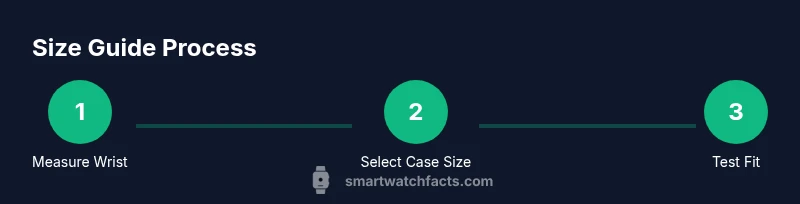
Wrap the measuring tape around the wrist where the watch would sit, just below the wrist bone. Keep the tape snug but not tight, and record the measurement in your preferred units. If you don’t have a tape, use a string and then measure it with a ruler. Take the measurement at different times of day to account for swelling.
Tip: Take measurements after a typical day of activity for a realistic fit. - 2
Choose case diameter range
Based on your wrist measurement, compare small-to-midsize options rather than jumping to a very large face. Visualize models side-by-side on your wrist to assess proportion and readability. Remember that the dial should be easy to read without looking off your wrist.
Tip: Prefer models with adjustable bands to fine-tune fit. - 3
Match band width to case
Select a band width that visually balances with the case and wrist. Narrow bands tend to look lighter but may feel unstable during vigorous activity; wider bands feel secure but can appear bulky on small wrists.
Tip: If unsure, start with a mid-width band and move up or down as needed. - 4
Test fit during activity
Wear the watch during activities you perform daily—typing, walking, lifting, and reaching. Ensure the watch stays in place and the sensor area isn’t obstructed by the band. Check for any rubbing or heat buildup.
Tip: Move your wrist through full range of motion to reveal fit issues. - 5
Adjust and compare again
If discomfort persists, try another strap style or another model within your size range. Ensure the clasp lies flat and the band can be altered to your preference. Re-measure if necessary and compare two or three options.
Tip: Choose a retailer with easy exchanges if your size isn’t perfect. - 6
Finalize choice and plan for adjustments
Make a final decision with confidence, considering adjustability, materials, and your daily needs. Ensure you have a flexible return policy and easy access to replacement bands or straps.
Tip: Opt for bands with quick-release pins for future resizing.
People Also Ask
What is the best smartwatch case size for small female wrists?
There isn't one universal size; start with small-to-mid options and test on your wrist with adjustable bands.
There isn't a universal best size; start small to mid and test on your wrist.
Does band width affect comfort for women?
Yes. Narrow bands sit closer and can feel lighter, while wider bands distribute weight more evenly. Choose based on activity and dress code.
Yes—band width affects comfort and stability; pick based on activity.
Can I wear a unisex smartwatch on a female wrist?
Yes, but check case diameter and strap options; adjustable bands help achieve a better fit.
Yes, but check size and adjustability.
How do I resize a watch band?
Many bands use quick-release pins or link removals. Follow the manufacturer’s instructions to avoid damage.
Many bands use quick-release pins; follow instructions.
What should I do if the watch feels too large after purchase?
Exchange for a smaller size or look for a model with a shorter strap and flexible return policy.
Exchange or adjust with a smaller strap.
Watch Video
Key Points
- Measure your wrist accurately before shopping
- Aim for a midsize case to suit most female wrists
- Use adjustable bands to accommodate changes
- Test fit during daily activities for real-world results
- Choose retailers with flexible exchanges for imperfect fits