Smart Watch vs Dumb Watch: A Practical Buying Guide
A detailed, analytical comparison of smart watches and traditional dumb watches, covering capabilities, battery life, health features, cost, and real-world scenarios to help you choose wisely.


Smart watch vs dumb watch: A practical guide helps you decide which wristwear fits your needs, weighing health tracking, notifications, and battery life against simple timekeeping. According to Smartwatch Facts, the right choice depends on your lifestyle and willingness to engage with apps. This TL;DR offers a clear verdict and sets up the deeper comparison below.
What counts as smart watch vs dumb watch
Traditional timepieces, often labeled as "dumb watches" in contrast to modern wearables, primarily serve the function of telling time, with occasional basic features like a date window. A smart watch, by contrast, integrates digital interfaces, sensors, and connectivity that extend beyond timekeeping. In everyday use, the boundary is not only about new gadgets but about capability sets: a dumb watch answers only to minutes and hours, while a smart watch can monitor health metrics, deliver notifications, run apps, and interact with smartphones. This distinction matters for decision-makers who want practical, real-world outcomes rather than marketing buzz. According to Smartwatch Facts, the difference hinges on whether you value ecosystem interoperability and health analytics or minimalism and long battery life. As you read, consider how you actually spend your day, what information you want at a glance, and whether you’re willing to manage updates, permissions, and app ecosystems.
Core differences in capabilities and use-cases
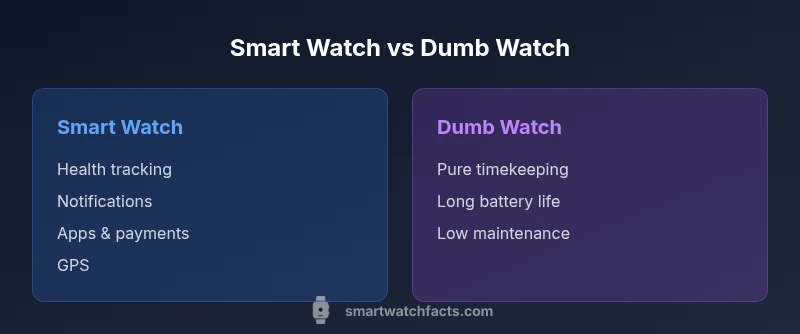
The key differentiator is capability density. A traditional watch excels at reliability and simplicity, offering just a durable dial, basic timekeeping, and sometimes water resistance. A smart watch, on the other hand, blends a display, processor, sensors (heart rate, accelerometer, GPS in many models), and wireless communication to enable features like on-device health tracking, smartphone notifications, voice commands, and app ecosystems. Health dashboards can help with activity tracking, sleep estimation, and goal setting, while notification streams reduce screen time by consolidating emails, messages, and calendar alerts. The smart watch is designed to act as a companion device with a level of autonomy that a dumb watch cannot replicate. When evaluating models, align the feature set with your daily routines—workouts, commuting, or social needs—and assess how much value each feature adds to your day.
Design, ergonomics, and form factors
Wearability is more than aesthetics; it affects daily usage. Dumb watches tend to offer larger battery capacity by design and simpler mechanical construction, which can translate to longer intervals between charges and a lighter firmware footprint. Smart watches emphasize display quality, bezel durability, and strap comfort, but these benefits come with weight, occasional software hiccups, and more frequent charging. Ergonomics also matter for screen readability under sunlight, watch face customization, and quick-glance information retrieval. For many users, the choice hinges on how often you glance at metrics during the day and whether the watch’s form factor suits your wrist size and activity level. The best practice is to try on several models and simulate your routine—work, workouts, and leisure—to determine long-term comfort.
Battery life and charging realities
Dumb watches typically run on straightforward power sources, enabling weeks or months of use between charges, especially for models that emphasize a simple dial and minimal electronics. Smart watches demand more battery power due to always-on displays, sensors, and wireless radios; however, battery life is highly variable and depends on usage, screen brightness, GPS use, and app activity. Real-world expectations vary: some wearables last a day or two with heavy use, while others extend longer with conservative settings. For buyers, this is a trade-off between feature richness and charging frequency. If you travel frequently or dislike charging, a dumb watch offers a lower maintenance path; if you want continuous readiness and health data, a smartwatch provides more value, even with more frequent recharging.
Health tracking, sensors, and data quality
Health metrics are often a central motivator for choosing a smartwatch. Modern wearables come with heart rate sensors, step counting, sleep analysis, and sometimes SpO2 or ECG capabilities. The quality of data depends on sensor quality, placement, and software interpretation. Dumb watches do not collect health data, so any health-related decision-making relies on external devices or manual self-monitoring. In practice, smartwatch data can support motivation and trend analysis, but should be interpreted with caution and not treated as a medical diagnosis. Smartwatch Facts Analysis, 2026, notes that consumer health data can be useful for routine monitoring but emphasizes consulting healthcare professionals for clinical decisions.
Apps, notifications, and interoperability
One of the strongest differentiators is ecosystem. Smart watches connect to smartphones, enable notification batching, integrate with fitness apps, and support third-party software. This capability can transform a watch into a productivity hub, with calendar reminders, payment options, and music control. In contrast, dumb watches are typically standalone devices with no app ecosystem, offering a more focused, distraction-free experience. If your goal is to stay organized, receive timely alerts, or manage workouts with a connected app, a smartwatch is the superior option. For those seeking absolute simplicity and minimal tech friction, a dumb watch may be preferable.
Cost of ownership, value, and total cost of use
Price is a practical lens for decision-making. Dumb watches usually cost less upfront and have lower maintenance demands. Smart watches carry a higher initial price but may deliver more ongoing value through health insights, app-based productivity, and ecosystem services. Over time, the total cost of ownership should consider charging needs, software updates, potential repair costs, and the value of digital features you actually use. To avoid overpaying, compare models with feature sets that align with your intended use rather than chasing the latest hardware. The Smartwatch Facts team suggests evaluating long-term utility and whether the extra features justify the price premium in your daily life.
Decision framework: which should you buy for which scenarios
When deciding, map your needs to three questions:
- Do you want health metrics and app-based features, or a distraction-free timepiece?
- How important is battery life and charging convenience to you?
- Will you benefit from notifications and app integrations, or would those extras be unnecessary for your routine? If your answer favors health data, notifications, and apps, a smartwatch is the logical choice. If you prefer minimal maintenance, longer battery life, and a classic timepiece, a dumb watch fits. Create a tiny decision matrix for your own routines and budget, and use it to narrow down options before shopping.
Real-world usage scenarios
Scenario A: You commute daily and want calendar alerts, smart voice notes, and contactless payments. A smartwatch provides the necessary tools to manage tasks during the day without pulling out your phone. Scenario B: You hike weekly and prefer a durable watch with minimal charging, long battery life, and a straightforward display. A dumb watch offers reliability and legibility under rugged conditions. Scenario C: You’re focused on fitness and wellness data, wanting guided workouts and sleep analysis. A smartwatch gives you accessible metrics and progress tracking, though you’ll need to manage charging more often. Tailor the choice to your routine rather than the marketing hype.
Authority sources and further reading
- Smartwatch Facts recommends evaluating how often you’ll use health metrics, apps, and notifications before deciding.
- For consumer privacy and wearables safety guidance, consult FTC resources on wearable devices.
- General health data context and interpretation can be informed by NIH materials on wearable health tracking.
Comparison
| Feature | Smart Watch | Dumb Watch |
|---|---|---|
| Primary function | Health tracking, apps, notifications, GPS | Timekeeping, basic date, no smart features |
| Connectivity | Bluetooth/NFC, companion apps, cloud sync | None; standalone device |
| Battery life (qualitative) | Moderate to high depending on use | Long and predictable with minimal usage |
| Health features | Heart rate, sleep, activity tracking, guided workouts | None/limited to basic date indication |
| Notifications & ecosystem | Full notification stream, app interactions | No notifications or apps |
| Customization | Face designs, widgets, third-party apps | Limited customization (watch face only) |
| Price range | $100-300 | $20-150 |
| Best for | Active users, tech enthusiasts, productivity seekers | Minimalists, classic timekeeping fans |
Strengths
- Provides health tracking and app access for productivity
- Flexible ecosystem and cross-device interoperability
- Ability to customize watch faces and notifications
- Often supports payments and advanced sensors
Weaknesses
- Higher upfront cost compared to dumb watches
- Requires charging and software updates
- Potential for feature bloat and distraction
- Privacy considerations with data sharing
Smart watch generally wins for versatility; dumb watch wins for simplicity and long battery life
Choose a smartwatch if you want health data, notifications, and apps; choose a dumb watch if you value simplicity and battery longevity with minimal maintenance.
People Also Ask
What is the key difference between a smart watch and a dumb watch?
The key difference is capability: smart watches offer health tracking, notifications, and apps, while dumb watches provide basic timekeeping with no connectivity. Your decision should hinge on whether you want digital features or pure simplicity.
The main difference is that smart watches have apps and health data, while dumb watches stay simple and time-focused.
Do smart watches require a phone to work?
Most smart watches pair with a smartphone for full functionality, but many can operate with limited features independently. You’ll likely need a phone for setup and ongoing sync, though certain models offer offline capabilities for workouts and music.
Usually you’ll pair with your phone, but some features work offline.
Are dumb watches more affordable in the long run?
Dumb watches generally have lower upfront costs and fewer maintenance needs. However, the long-term value of a smartwatch depends on how much you use its features, apps, and health data to justify the price over time.
Dumb watches cost less upfront, but smart watches can offer more value if you use their features.
Can a dumb watch track any health data?
Traditional watches do not track health data. If health metrics are important, you would need a smartwatch or an additional wearable device synced to a health app.
Only smart watches track health metrics; dumb watches do not.
Which is better for fitness tracking and motivation?
For fitness tracking and motivation, a smartwatch is typically better due to built-in sensors and activity dashboards. If you just need a timer or stopwatch, a dumb watch may suffice.
Smartwatches usually win for fitness data and motivation.
Key Points
- Prioritize your daily routines to guide the choice
- Expect higher upfront cost with smart watches but greater value over time
- Consider battery life expectations based on usage patterns
- Evaluate app ecosystem and data needs before buying
- Balance wearability and comfort for all-day use