What Sizes Do Smart Watches Come In? A Practical Guide
Discover what sizes smart watches come in, how to choose the best fit for your wrist, and practical tips for measuring and trying on models for shoppers.


According to Smartwatch Facts, what sizes do smart watches come in? Most mainstream models use case diameters around 38–46 mm, with a few rugged lines at 50 mm. The fit depends on wrist circumference and band style, so compare brands and try on sizes for the best result. If you have a small wrist, consider 38–40 mm; if you have a larger wrist, 44–46 mm works well.
How sizing is defined in modern smartwatches
Smartwatch case size is primarily described by diameter, but the fit is influenced by lug-to-lug distance, thickness, and strap width. The phrase "what sizes do smart watches come in" is something many shoppers ask, and the practical answer is that sizes cluster in a few standard ranges. In practice, most mainstream watches come in diameters from about 38 mm to 46 mm. Some rugged or fashion-forward lines push toward 50 mm. The choice between these sizes isn't just about wrists' circumference; it's also about how you wear the watch (tight vs. loose), the strap style (rubber vs. leather), and personal comfort. The Smartwatch Facts team found that the perceived size on the wrist depends on both the case and the band; thus, you should evaluate the entire package, not just the numeric diameter. For this reason, retailers frequently offer multiple sizes or interchangeable bands to accommodate different wrist shapes.
Common size ranges you will encounter
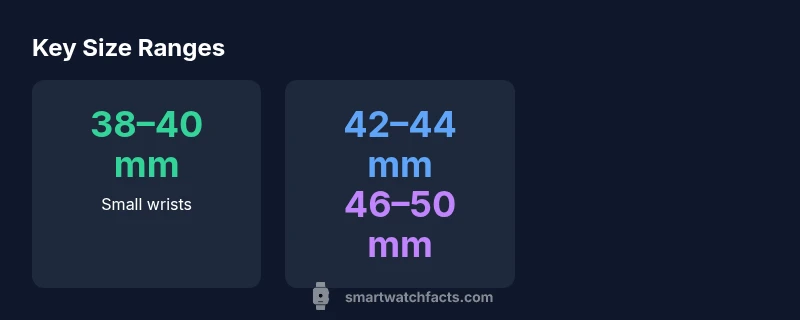
Within the mainstream market, the vast majority of smartwatches fall within 38–46 mm. This window balances visibility and comfort for most adult wrists. The smaller end, around 38–40 mm, appeals to users with slender wrists or preference for a discreet look; the mid-range 42–44 mm suits many wearers; and the larger 46–50 mm is favored by those seeking a bold presence or with broader forearms. It's important to note that two people with the same wrist circumference may feel different on the wrist depending on lug-to-lug measurement, bezel design, and strap offset. Based on Smartwatch Facts research, labeling can vary by brand; some brands market 40 mm, 41 mm, or 44 mm as standard sizes, while others group them into S/M/L. When shopping, try on both a smaller and a larger option if possible to gauge comfort.
Fit considerations by wrist size and shape
Wrist size is the most practical predictor of fit. For compact wrists (roughly under 165 mm in circumference), a 38–40 mm model tends to disappear on the wrist and feels lighter during daily wear. For average wrists (about 165–190 mm), 42–44 mm provides a balanced look and comfortable interaction with touchscreens. For larger wrists (over 190 mm), 46–50 mm offers a bolder aesthetic and improved screen readability, assuming the strap length accommodates the circumference. Remember that lug-to-lug distance and strap style can alter perceived size more than you expect; a shorter lug-to-lug with a roomy strap can often feel smaller than a longer lug-to-lug with a tight strap. Consider trying both small and large options if possible to get a true sense of comfort.
How to measure your wrist and try on sizes in practice
To determine your ideal smartwatch size, start with an accurate wrist measurement. Use a flexible tape measure around the wrist bone, just above the wrist joint, and record the circumference in millimeters. Then compare this measurement to common size ranges (38–40 mm, 42–44 mm, 46–50 mm) and account for lug-to-lug length, case thickness, and band width. If you can, visit a store to try several models in person, paying attention to how the watch sits with different bands (silicone, metal, leather). If you order online, check the retailer's return policy so you can swap sizes easily. Finally, remember that some brands offer adjustable bands or interchangeable straps, which can dramatically change fit without changing the case size.
Brand differences in sizing and what to look for when shopping
Brand sizing strategies vary, which is why the same numeric size can feel different across manufacturers. Look beyond the diameter and inspect lug width, band width, and overall case geometry. A 44 mm label on one brand might feel similar to a 46 mm label on another due to bezel size or display area. Choose models with easily adjustable bands and consider purchase from retailers that provide quick returns or free exchanges. For shoppers who care about consistency, select models offering two or more size options and standard lug widths to maximize strap compatibility. The Smartwatch Facts team notes that the best approach is to compare multiple brands side by side and rely on try-on experiences to confirm fit; in practice, size is about how the watch sits and moves on your wrist, not just the digits.
Smartwatch size ranges by case diameter
| Size bracket | Typical case diameter (mm) | Fit notes |
|---|---|---|
| Small/compact | 38–40 | Best for slender wrists |
| Standard/average | 42–44 | Balanced fit for most wrists |
| Large | 46–50 | For larger wrists or bold style |
People Also Ask
What is the most common smartwatch size?
Most mainstream wearables fall in the 38–46 mm range, with 42–44 mm being particularly popular due to balance of readability and comfort.
Most wearables today fall between 38 and 46 millimeters, with 42 to 44 millimeters especially common.
Do different brands use different size labels?
Yes. Some brands label sizes as 40, 41, or 44 mm, while others use designations like S/M/L or different naming conventions. Always check the actual diameter.
Brand labels can vary; always check the actual millimeter size rather than the name.
Can I wear a large smartwatch on a small wrist?
A large model can feel bulky on a small wrist. If possible, try smaller sizes or adjustable bands to improve comfort.
A large watch can feel bulky on a small wrist; try a smaller size or swap to a flexible band.
How should I measure my wrist for sizing?
Use a flexible tape around the wrist bone, where the wrist is widest, and note the circumference in millimeters. Compare to standard size ranges.
Wrap a flexible tape around your wrist to measure its circumference.
Do smartwatches offer interchangeable bands?
Yes. Many watches use quick-release bands and standard lug widths, making it easy to swap sizes and adjust fit.
Most watches let you swap bands to improve the fit.
What else should I consider besides diameter?
Look at lug-to-lug distance, bezel size, thickness, and strap length, since these affect wear and comfort.
Consider lug-to-lug, thickness, and strap length for a good fit.
“Sizing is a practical matter of comfort and visibility; choose the size that sits crisply on your wrist without feeling bulky.”
Key Points
- Measure your wrist to pick a diameter range.
- Most mainstream sizes are 38–46 mm.
- Larger models suit larger wrists or bold style.
- Brand labeling varies; try-ons are essential.