Which Smartwatch Is Better: Apple vs Wear OS in 2026
A rigorous, analytical comparison of the leading smartwatch ecosystems to help you decide which smartwatch is better for your needs in 2026. Explore ecosystem compatibility, health features, battery life, price, and practical buying guidance.


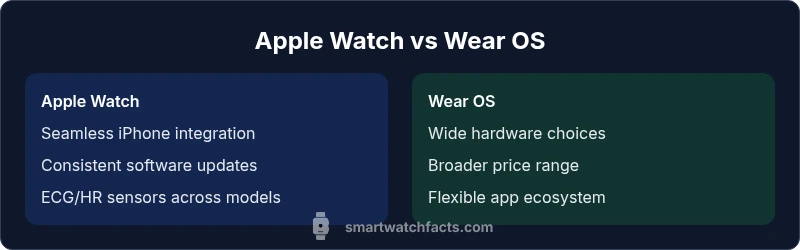
Apple Watch and Wear OS watches each shine in different areas. If you own an iPhone and want deepest ecosystem integration, the Apple Watch is usually the better pick. If you prefer wider hardware options, more price points, and flexible app choices, a Wear OS smartwatch offers strong value. The best choice ultimately depends on your ecosystem, budget, and how you use health and productivity features.
The core question: what does 'better' mean?
When readers ask which smartwatch is better, they’re usually weighing ecosystem compatibility, health-tracking reliability, and overall value against price. But the right answer depends on how you plan to use the device, what smartphone you own, and which features you actually rely on daily. This section reframes the question from a simple ranking to a practical framework: define your top priorities, examine how each platform delivers on those priorities, and choose the option that minimizes compromises for your specific lifestyle. As you scan this analysis, keep in mind that Smartwatch Facts emphasizes actionable guidance rather than abstract superiority claims. If you’re an
Core criteria: reliability, ecosystem, and compatibility
The heart of any smartwatch decision is threefold: reliability of tracking and notifications, the strength and breadth of the app ecosystem, and how well the watch integrates with your primary devices. Reliability includes sensor accuracy for heart rate, SpO2, sleep, and activity metrics, as well as software stability and timely updates. The ecosystem dimension covers not only native apps but also third-party integrations, voice assistants, and health services. Compatibility concerns whether the watch plays nicely with your phone (
Apple Watch vs Wear OS: ecosystems and app strategies
The Apple Watch sits at the center of Apple’s tightly integrated ecosystem. If you own an
Health sensors and health data interpretation
Health sensing is a core battleground for smartwatches. Apple Watch models have established a robust baseline for heart-rate monitoring, ECG, and SpO2, with a reputation for consistent tracking across most workouts and daily activities. Wear OS devices vary more due to the number of participating manufacturers (Samsung, Fossil, Mobvoi, and others). This means some Wear OS watches offer top-tier sensors and precise tracking, while others lag behind or rely on algorithmic improvements through software updates. When evaluating health data, look beyond the headline sensor list and examine the data continuity, calibration methods, and how well the app ecosystem translates raw metrics into actionable insights (calorie estimates, sleep staging, or VO2 max estimates).
Smartwatch Facts observes that most users benefit from comparing two factors: sensor quality under real workloads (during runs, intervals, or sleep) and the reliability of the companion health platform (Apple Health vs Google Fit). If health tracking is your primary motivation, prioritize devices and apps with proven long-term data consistency and a clear roadmap for future improvements.
Battery life, charging, and day-to-day usage
Battery life is a practical anchor for day-to-day satisfaction. Apple Watches typically offer a predictable daily cycle, with charging needs that align with a morning routine or during work breaks. Wear OS devices span a wider range: some models optimize aggressively for longevity, while others prioritize thinner profiles or faster charging. If you regularly forget to charge, you’ll want a watch with at least a day and a half of battery life, plus reliable charging speeds. Consider use cases that drain the battery: always-on display, GPS-intensive workouts, and continuous heart-rate monitoring. In real-world terms, you should expect a chic, compact wearable to keep pace with a busy day, but your tolerance for recharging frequency will shape which platform feels “better” to you.
A balanced approach is to estimate your daily routines and simulate them over a few days with each platform. That practical test often reveals subtle differences that raw specs can’t capture. Smartwatch Facts emphasizes testing scenarios that matter most to you—commuting, workouts, or heavy app usage—before deciding which smartwatch is better for your lifestyle.
Design, comfort, and durability in daily wear
Comfort and durability are more than skin-deep considerations. A watch’s weight, strap material, and overall ergonomics influence whether you’ll wear it all day, every day. Apple Watch models tend to emphasize a slim profile and a premium finish with a consistent design language across generations, which can simplify pairing with different outfits and accessories. Wear OS watches vary in cases, sizes, and materials, offering broader customization options but sometimes at the cost of uniform build quality. Durability metrics—water resistance, screen sturdiness, and scratch resistance—matter if you’re active or frequently around water. Check IP ratings, MIL-STD durability claims, and bezel protection when your routine includes aquatic sports or rugged environments. In practice, the best choice often comes down to comfort for extended wear and your willingness to accept minor design compromises for flexibility. A well-fitting band and a screen you can read in bright sun are small but meaningful factors in long-term satisfaction.
Software updates, longevity, and support
Software updates are the unseen backbone of long-term satisfaction. Apple has a track record of delivering consistent OS updates across devices for many years, which means older Apple Watch models may stay relevant longer than some rivals. Wear OS’s longevity depends more on the manufacturers behind the devices and how aggressively they push updates, which can lead to uneven support across models. If you plan to keep the watch for several years, prioritize platforms with a clear, ongoing update policy and a robust user base. The best strategy is to confirm the expected support window for the exact model family you’re considering and to check the cadence of major feature updates (health, battery optimization, privacy controls).
Overall, while Apple’s ecosystem offers predictable longevity, Wear OS can deliver extended value on devices from trusted brands that emphasize update commitments and long-term support.
Pricing, value, and total cost of ownership
Price often dictates feasibility. Apple Watch models tend to carry a premium that reflects the premium finish and integrated software experience, whereas Wear OS watches cover a broader spectrum of price points, with some options designed to deliver strong value for budget-conscious buyers. When evaluating price, look beyond the sticker price and include accessories, charging gear, and potential app subscription costs. Total cost of ownership matters more than the upfront price; a cheaper watch that requires frequent app purchases or has limited durability can end up being more expensive over time. Smartwatch Facts recommends mapping your expected annual costs for the device’s lifespan and comparing it against the anticipated feature set you actually use. The best choice balances upfront affordability with long-term value.
To avoid sticker shock, identify the minimum feature set you require (GPS, heart-rate monitoring, offline music, NFC payments), then compare devices that hit that baseline without unnecessary extras. The result is a clear signal about which smartwatch is better aligned with your budget and needs.
Practical buying framework: step-by-step guide
Decision quality improves when you follow a repeatable framework. Step 1: determine your primary device ecosystem (
Real-world case studies and scenarios
To ground the analysis, consider two representative user personas: a busy
Comparison
| Feature | Apple Watch (Apple ecosystem) | Wear OS smartwatch (Android ecosystem) |
|---|---|---|
| OS & app ecosystem | Closed Apple ecosystem with strong health apps | Open Wear OS ecosystem with broad app support |
| Battery life | Typically structured around a daily use cycle | Wide variance; some models last longer with lighter features |
| Health sensors & data | High-quality HR, ECG, SpO2 across recent generations | Diverse sensors; consistency depends on model and manufacturer |
| Compatibility with iPhone | Best with iPhone; limited cross-platform parity | Broad Android compatibility; limited iPhone parity |
| Price range | $199-$799 depending on series and generation | $149-$650 depending on brand and features |
| Best for | iPhone users seeking seamless integration and health features | Android users seeking choice, affordability, and customization |
Strengths
- Clear ecosystem advantages: Apple Watch for iPhone users
- Strong health-tracking suite and ECG on many models
- Broad app availability and flexibility on Wear OS
- Value-oriented options across Wear OS price points
- Extensive hardware choices from multiple brands in Wear OS
Weaknesses
- Walled ecosystem can limit cross-platform usability for Apple Watch
- Battery life varies more widely on Wear OS depending on model
- Health data accuracy varies by sensor and device
- Software updates can be slower or uneven across Wear OS devices
Neither option is universally better; your ecosystem and priorities decide.
Apple Watch excels for iPhone users focused on seamless health and app integration. Wear OS watches offer richer hardware variety and pricing flexibility, appealing to Android users. Your choice should hinge on ecosystem compatibility, battery expectations, and which apps you rely on most.
People Also Ask
Which smartwatch is better for iPhone users?
For iPhone users, the Apple Watch generally offers the most seamless integration of health, notifications, and apps. Wear OS can pair with iPhone, but its functionality is more limited.
For iPhone users, Apple Watch usually provides the smoothest experience; Wear OS works, but with fewer features.
Do Wear OS watches work with iPhone?
Wear OS watches can pair with iPhone, but they lack full feature parity and some apps may require an Android device.
Wear OS watches pair with iPhone, but expect limited features.
Is battery life predictable across Apple Watch and Wear OS?
Battery life varies widely by model and usage; both ecosystems offer models that last a day or more, but real-world use depends on features enabled.
Battery life varies by model and use; expect about a day or two with typical use.
Are health sensors more accurate on Apple Watch?
Apple Watch is known for consistent heart-rate and ECG tracking, but Wear OS devices vary by manufacturer; compare sensors rather than rely on a single brand.
Apple Watch is often precise for heart-rate, but accuracy depends on the model.
Should cost be the main deciding factor?
Price matters, but value comes from ecosystem compatibility and desired features; consider total cost of ownership including accessories and potential app costs.
Cost matters, but don’t overlook ecosystem and app support.
What about durability and water resistance?
Most mainstream models offer water resistance and durable builds, but ensure you match the rating to your activities; check IP ratings and durability standards.
Look for water resistance ratings and rugged design.
Key Points
- Define your ecosystem first
- Assess battery expectations before buying
- Prioritize health features you actually use
- Compare price-to-feature value for your budget