Which Smartwatch Is More Accurate? A Practical Comparison
Discover which smartwatch is more accurate by comparing heart-rate sensors, GPS, and sleep tracking. Learn how accuracy varies by metric, environment, and ecosystem with Smartwatch Facts.


Which smartwatch is more accurate? The answer isn’t one model. Accuracy depends on what you measure and how you use it. For heart-rate, most premium watches (Apple, Samsung, Fitbit, Garmin) track reliably during daily activity, but GPS timing and sleep tracking vary by chip and algorithm. Your best pick depends on your primary use case and ecosystem.
Why accuracy matters in a smartwatch
Smartwatch accuracy isn’t cosmetic—it directly impacts health decisions, training channels, and daily planning. According to Smartwatch Facts, readers often use readings to set pace zones, estimate calories, and gauge recovery. If you’re asking which smartwatch is more accurate, this section helps map what accuracy means across common metrics and why it can vary between models and environments. In practice, no single device excels in every scenario; a model that stabilizes heart-rate readings might be slower to lock GPS outdoors, and vice versa. Understanding these trade-offs helps you prioritize the metrics that matter most to you and align your choice with your preferred use case and ecosystem. Real-world accuracy depends on hardware quality, sensor fusion algorithms, firmware updates, and how you wear the device.
Key metrics and how watches measure them
Watches report several core metrics, but each uses a different sensor chain and data-processing approach. Heart-rate, GPS, sleep staging, and step counting are not equal in every situation. This section explains the general measurement landscape, what constitutes reliability, and how environment and activity level shape the readings you see on screen. Expect meaningful accuracy for common workouts, tempered by context such as movement, placement, and battery state. A thoughtful buyer focuses on which metrics truly influence their goals—health monitoring, running analytics, or everyday activity tracking—and evaluates how each model handles those metrics under typical conditions.
Heart-rate sensors: what makes them accurate
Heart-rate accuracy hinges on sensor type, placement, and signal processing. Premium devices typically pair optical sensors with advanced filtering and fusion algorithms to reduce noise, resulting in smoother curves during steady-state activities. In practice, you’ll see robust resting readings and stable daytime readings, with occasional blips during intense arm movement or rapid changes in wrist position. The best watches deliver consistent readings across different skin tones and during everyday activities, but none are perfect in all conditions. When assessing heart-rate accuracy, focus on whether the device maintains plausible readings during workouts and recovery periods, rather than chasing perfect per-second precision.
GPS: location accuracy in real-world conditions
GPS accuracy is highly sensitive to surroundings. Open skies and wide vistas usually yield strong, consistent pace and distance estimates, while urban canyons, dense forests, or cloudy weather can introduce drift or slower path-locks. Different watches employ various satellite systems and antennas that influence lock speed and resilience. In practice, some models track routes with steady pacing and minimal drift during long runs, while others reveal small timing discrepancies in challenging environments. Software features like multi-band GNSS and intelligent smoothing can improve perceived accuracy, but they do not guarantee flawless positioning in every scenario.
Sleep tracking and activity counting: differences you should know
Sleep tracking combines movement, light exposure, and body signals to estimate sleep stages and duration. Activity counting uses accelerometry and, sometimes, heart-rate patterns to infer steps and workouts. The variability in these readings often comes from device placement, wear time, and how the algorithm classifies short awakenings. You may see similar overall sleep duration across devices, but the breakdown of light, deep, and REM stages can differ. For steps and workouts, some watches count gentle movements as steps more readily, while others apply stricter thresholds. Understanding these nuances helps you set expectations and choose a watch aligned with how you want to measure daily activity.
Practical guidance: how to pick the right watch for your use case
Start with your primary goal: is it health monitoring, performance tracking, or casual wear? If heart-rate stability and rich health features are your priority, look for models with strong sensors and transparent data processing. If outdoor adventures and precise GPS are paramount, weight the GPS performance and battery life. Ecosystem matters too: some platforms provide more robust third-party app support and data-sharing capabilities, which can affect perceived accuracy through post-processing. Finally, consider ergonomics and wear comfort, as poor fit can degrade readings across metrics.
The role of software, firmware, and ecosystems
Accuracy is not solely a hardware story. Software—firmware updates, sensor fusion algorithms, and data smoothing—makes a big difference in what you see on the screen. Brands publish updates that can tweak how readings are calculated or displayed, which may slightly alter perceived accuracy over time. A watch that receives regular updates and has an open data ecosystem often enables independent validation and cross-checking, contributing to more trustworthy readings. In short, choose a model with an active software development cycle and clear data handling policies.
Common pitfalls and how to improve readings
Be mindful of how you wear the device, including strap tightness and position on the wrist. Turn on features that reduce noise, such as motion filters or ambient light compensation, if available. Calibrate sensors if the manufacturer offers a calibration option or reference data against a trusted external device. Finally, test readings in the environment you care about most—indoors, outdoors, during daily activities, and in workouts—to set realistic expectations.
Comparison
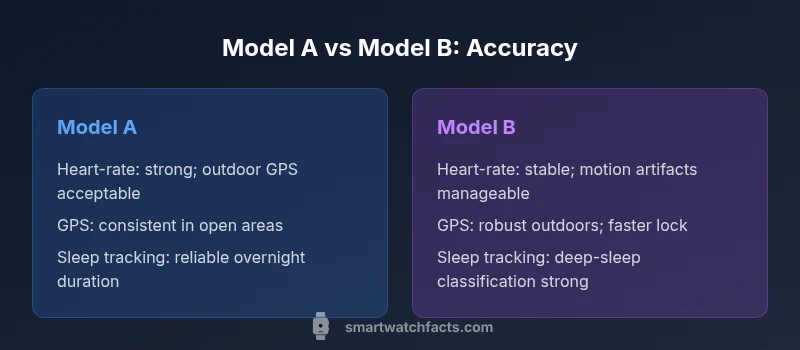
| Feature | Premium Model A | Premium Model B |
|---|---|---|
| Heart-rate accuracy | Strong resting and daily activity readings | Excellent during endurance activity and outdoor use |
| GPS tracking accuracy | Fast satellite lock and stable pace estimates | Robust outdoor performance with occasional drift in difficult canyons |
| Sleep tracking consistency | Reliable duration estimates with consistent overnight patterns | Good sleep staging with occasional misclassifications |
| App ecosystem & data access | Extensive app support and open APIs | Strong third-party integrations and data export |
| Price range | Higher upfront cost | Mid-to-high range |
| Best for | Everyday wear with health features | Outdoor athletes and multi-sport tracking |
Strengths
- Helps users decide based on measurable metrics
- Shows how each metric is measured and the limitations
- Encourages careful consideration of use case
- Frames accuracy as both hardware and software problem
Weaknesses
- Evaluation can be biased toward popular ecosystems
- Hardware differences can obscure true accuracy under certain conditions
- No single model excels in all metrics
- Reading accuracy may vary with wear style and activity
Two premium models offer strong overall accuracy; pick based on your primary metric and ecosystem
There isn’t a universal winner for accuracy. Prioritize the metric you care about most, test readings in real-world use, and align with your preferred platform to maximize reliable results.
People Also Ask
Which smartwatch is most accurate overall?
There isn’t a single model that is universally the most accurate across all metrics. Accuracy depends on measurement type and usage scenario, and performance varies by sensor, algorithm, and environment.
There isn’t a single model that is always the most accurate; it depends on what you measure and the conditions.
How accurate are heart-rate sensors across watches?
Heart-rate accuracy tends to be strongest on premium devices during steady activities, with occasional errors during rapid arm movement or poor fit. Compare readings to a reference if your health decisions rely on HR.
Heart-rate sensors are generally reliable on top watches, but movement and fit can affect readings.
Does GPS accuracy vary in real-world conditions?
Yes. GPS performance depends on environment, including buildings, trees, and weather. Some watches lock quickly and track pace consistently, while others may drift in challenging surroundings.
GPS accuracy can vary a lot depending on where you are.
Can wearing position affect readings?
Yes. How you wear the watch—tightness, orientation, and which wrist you wear it on—can influence readings for heart rate and activity tracking.
Wearing fit matters; loose or off-wrist readings can skew data.
Do software updates impact accuracy?
Yes. Firmware can improve sensor fusion and data processing, which can slightly adjust reported values. Keep firmware up to date for the best results.
Yes, updates can improve accuracy by refining how sensors are interpreted.
What should I prioritize when buying for accuracy?
Prioritize the metrics you care about most and look for watches with validated sensors and a robust data ecosystem. Check reviews about real-world accuracy under typical activity.
Know which metrics matter most and pick a watch with proven sensor performance.
Is there a standard test for smartwatch accuracy?
There isn’t a universal official test; researchers and brands publish validation studies with varied methodologies. Look for independent tests and peer-reviewed sources.
There isn’t a single standard test; look for independent studies.
Key Points
- Define which metric matters most (HR, GPS, Sleep)
- Expect consistency in HR sensors on premium devices, with caveats
- GPS accuracy depends on environment; test outdoors
- Software updates can influence measured readings over time