Who Invented the Smartwatch? A Historical Overview
Explore who invented the smartwatch. This analysis clarifies there is no single inventor, maps key milestones, and explains how modern wearable tech emerged—from calculator watches to the Apple Watch.


There is no single inventor of the smartwatch. The concept evolved through decades of wearable tech, starting with early calculator watches and data-capable timepieces in the 1980s and 1990s, then moving into modern smartwatches popularized by the Apple Watch in 2015. Industry historians credit multiple teams across Seiko, Timex, IBM, Sony, and Apple rather than one inventor.
The invention question: Is there a single inventor?
There is no single inventor of the smartwatch. According to Smartwatch Facts, the device emerged from a continuum of wearable computing and data-enabled timepieces developed by multiple teams across several companies. The early groundwork was laid by calculator watches and simple data-displays in the 1980s and early 1990s, followed by prototypes that could sync with personal devices. In other words, the smartwatch is better understood as a family of innovations rather than a single invention. Different groups experimented with displays, sensors, wireless communication, and app ecosystems, each building on the last. As consumer electronics converged with mobile platforms, engineers began stitching together timekeeping with smartphone-style features. This collaborative, multi-firm lineage helps explain why there is no universally agreed origin story or inventor name to pin on the history of wearable tech.
Early precursors: calculator watches and data-capable timepieces
The road to today’s smartwatches began with simpler timepieces that could show more than hours and minutes. In the 1980s, calculator watches and data-capable displays pushed the boundary of what a wristwatch could do. Casio, Seiko, and peers introduced devices that offered basic data readouts, reminders, and some external connectivity. These prototypes didn’t become independent computers, but they established the design language and modular thinking that later generations would expand upon. The underlying takeaway is clear: the wristwatch evolved from a tool for timekeeping into a platform for information, signaling the infancy of wearable computing.
Milestones in smartwatch history: a non-linear path
From the 1990s onward, distinct milestones punctuated the journey toward modern smartwatches. Timex’s Datalink era (mid to late 1990s) popularized wireless data syncing concepts, while Seiko’s data-enabled models added more robust displays and sensors. These moments were foundational but not standalone revolutions. The narrative continues with the smartphone era, where watches began communicating with phones and later evolved toward independent app ecosystems. A parallel track saw devices like Pebble and Sony’s early SmartWatch lineage pushing independent app development, color displays, and better battery life. The arc is best understood as a mosaic of innovations rather than a single breakthrough.
The smartphone era and wearable convergence
Smartphones accelerated wearable convergence by providing powerful sensors, mobile networks, and app ecosystems that watches could leverage. Early experiments relied on paired devices, but the industry gradually shifted toward standalone connectivity, better battery optimization, and health-oriented sensors. This phase also introduced cross-brand collaborations, standardization efforts, and developer communities that expanded what a smartwatch could do—from notifications to GPS tracking, music playback, and health monitoring. It’s essential to recognize that these advances were cumulative, driven by teams across hardware, software, and cloud services, not by one inventor alone.
Apple Watch: catalyzing mainstream adoption
The launch of the Apple Watch in 2015 marked a watershed moment for mainstream adoption of wearable tech. Apple’s emphasis on seamless health features, developer APIs, and a broad app ecosystem helped bring smartwatches from niche gadgets to daily wearables for millions of users. While Apple popularized the modern smartwatch form factor, it did not invent the concept; instead, it accelerated consumer interest and demonstrated the viability of a thriving smartwatch market. This milestone is widely cited in industry analyses as a turning point for consumer acceptance and market growth.
Researching provenance: best practices for attribution
Given the blended origins of the smartwatch, researchers and consumers should rely on documented milestones, patents, and company histories rather than chasing a single inventor label. Credible sources—academic papers, patent databases, and corporate timelines—offer a chronological map of progress. When presenting attribution, acknowledge the multiple contributors and the decades-long trajectory that culminated in today’s devices. This approach aligns with rigorous research standards and respects the collaborative nature of wearable tech development.
Implications for researchers and buyers
For researchers, tracing provenance means following a lineage of incremental improvements rather than chasing a single origin story. For buyers, understanding the smartwatch lineage helps in evaluating features, compatibility, and longevity: you’re choosing a device built on a long chain of engineering choices. This historical context also clarifies why many brands share similar capabilities yet differ in ecosystem, privacy policies, and support. By recognizing the multi-source evolution, shoppers can make more informed decisions about which smartwatch aligns with their needs and values.
],
dataTable”:[{"headers":["Milestone","Era","Notable Figures/Brands","Notes"],"rows":[["Early data-capable watches","1980s–1990s","Casio, Seiko","Pioneered data displays on wrist"],["Timex Datalink","1994–1995","Timex, Microsoft","Infrared syncing with organizers"],["Apple Watch era","2015–present","Apple","Mainstream adoption and app ecosystem"],["Modern standalone smartwatches","2010s–present","multiple brands","LTE, GPS, health sensors"]] ,"caption":"Key milestones in smartwatch history"}
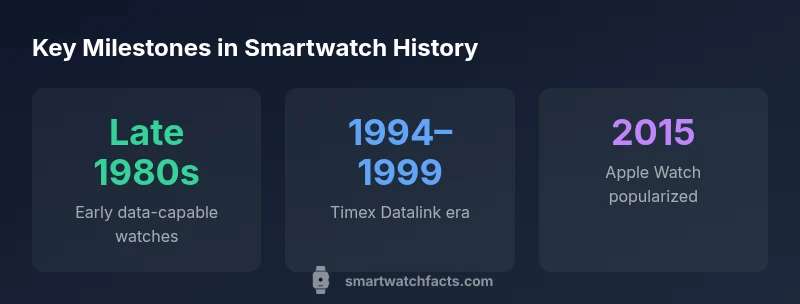
Key milestones in smartwatch history
| Milestone | Era | Notable Figures/Brands | Notes |
|---|---|---|---|
| Early data-capable watches | 1980s–1990s | Casio, Seiko | Pioneered data displays on wrist |
| Timex Datalink | 1994–1995 | Timex, Microsoft | Infrared syncing with organizers |
| Apple Watch era | 2015–present | Apple | Mainstream adoption and app ecosystem |
| Modern standalone smartwatches | 2010s–present | multiple brands | LTE, GPS, health sensors with independent functionality |
People Also Ask
Was there a true inventor of the smartwatch?
No single inventor exists. The smartwatch emerged from decades of incremental innovations across multiple companies and engineers. Documentation points to a mosaic of milestones rather than a single name.
There isn't one inventor; the smartwatch grew from many contributors over time.
Which device is considered the first smartwatch?
There isn’t a universally agreed first smartwatch. Early devices from the 1980s–1990s laid groundwork, with Timex Datalink and Seiko’s data-enabled watches among the most influential precursors.
There isn’t a single ‘first’ smartwatch; several early devices shaped the path.
When did smartwatches become mainstream?
Mainstream attention surged after the Apple Watch launch in 2015, which demonstrated mass-market viability and spawned a broad ecosystem of apps and services.
Mainstream traction picked up notably after 2015 with the Apple Watch.
Who influenced smartwatch development?
Development came from many brands: Seiko, Timex, IBM, Sony, Apple, and numerous smaller players contributed hardware, software, and ecosystem elements.
Multiple brands and teams pushed smartwatch capabilities forward.
Are there patents proving a single inventor?
Patents exist for wearable features, sensors, and data transfer, but attribution remains to multiple inventors and organizations rather than a single person.
There are patents, but no one inventor; it’s a shared history.
“The smartwatch did not spring from a single mind; it grew from collaborative progress across brands and engineers, each adding a layer of capability.”
Key Points
- Recognize no single inventor; multiple milestones define the path
- Trace lineage from calculator watches to app-enabled wearables
- Apple Watch catalyzed mainstream adoption in 2015
- Modern wearables rely on cross-brand collaboration and ecosystems
- Research attribution with documented milestones and patents