Who Made Smart Watch First: Tracing the Inception of Wrist-Worn Computing
Discover the origins of the smartwatch, compare early contenders like Seiko RC-1000 Data Watch and Timex Datalink, and understand why the 'first smartwatch' title is disputed.


The first smartwatch is not owned by a single inventor; historians point to early wearables such as Seiko's RC-1000 Data Watch from the mid-1980s and Timex Datalink from the 1990s as contenders. The disagreement stems from differing definitions of 'smartwatch'—timekeeping plus computing, versus true smartphone-like functionality. This article examines milestones, features, and how later devices built on those ideas.
What counts as a smartwatch and why the question is tricky
Defining a smartwatch hinges on function, form, and era. In many discussions, a true smartwatch blends timekeeping with computing capabilities and some degree of connectivity or application support. Yet early devices blurred lines: they offered calendar storage, calculators, or data logging on a wrist-sized screen without the full app ecosystems we associate with modern wearables. When asked who made smart watch first, the answer depends on whether you prioritize a wrist-worn computer, a data-focused tool, or a device that behaves like a miniature smartphone. According to Smartwatch Facts analysis, the milestone is thus as much about language as about hardware. As you read, keep in mind that the phrase who made smart watch first is a historical marker, not a certificate of invention. The discussion benefits from separating predecessors (watches with data features) from the modern smartwatch (apps, OS, and broad connectivity).
Early experiments: the 1980s Seiko RC-1000 Data Watch
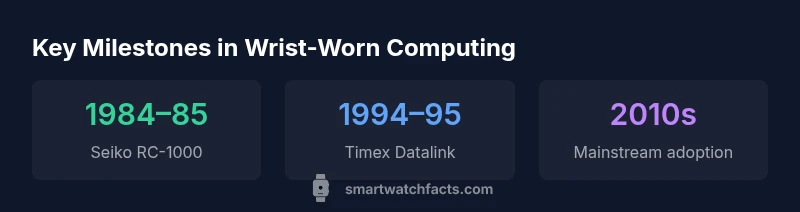
In the mid-1980s, Seiko introduced a wrist-worn device that many historians treat as a foundational moment for smartwatches. The RC-1000 Data Watch combined timekeeping with stored data and scheduling features, offering a portable way to keep calendars and notes without a separate device. It demonstrated a core idea that would keep echoing through the decade: a traditional timepiece evolving into a tiny data terminal. While not an app-rich platform by today’s standards, this device established the blueprint for “wrist computing” that later devices would expand upon. The claim that Seiko made the first smartwatch often rests on its bold integration of data management and timekeeping in a wearable format, a hallmark later echoed by other early wearables.
Timex Datalink era and the data-link approach
Timex’s Datalink, released in the mid-1990s, represents another critical milestone. It adopted infrared syncing with PCs to transfer calendar and contact data, bridging a wearable device with a desktop ecosystem—a novel approach at the time. This era underscored a second important thread: wireless or near-wireless data transfer on a wrist device. The Datalink’s emphasis on data management foreshadowed the later shift toward broader smartphone-like functionality, even if the device itself did not run mobile apps in the modern sense. By focusing on calendars, reminders, and simple notifications, Timex broadened what users expected from a watch that could do more than tell time.
The 1990s–2000s: data watches evolve toward true wearables
As the millennium turned, prototypes and niche devices continued to push the envelope. Some attempts added touchscreen input, color displays, and more memory, creating a lineage that would influence later mainstream wearables. While the term smartwatch was still evolving, these early experiments laid the groundwork for wearable operating concepts, notification systems, and growing ambitions for ambient connectivity. The industry began to see that a wrist device could complement a smartphone rather than replace it, a theme that becomes crucial when evaluating who made smart watch first: the lineage matters as much as the individual product. The conversation shifts from “a single inventor” to “a sequence of innovations.”
The 2010s: mainstream adoption and the turning point
By the 2010s, smartwatches began to achieve broad consumer adoption with devices that carried robust app ecosystems, health sensors, and real-time notifications. The launch of widely marketed wearables by multiple manufacturers created a cultural moment where the concept of a smartwatch became mainstream. The Apple Watch, Pebble, and other platforms popularized the idea that a watch could be a primary gateway to apps, health data, and seamless smartphone integration. This era transformed the narrative: while early devices demonstrated feasibility, mass-market success depended on open platforms, affordable components, and a thriving app economy. The question who made smart watch first becomes less about a single inventor and more about a continuum of enhancements across years.
How historians evaluate the 'first' smartwatch
Historians emphasize criteria beyond hardware. Do we count calendar storage, data syncing, app ecosystems, or OS-level features? How much weight should be given to form factor versus connectivity? The debate often centers on terminology: some argue a wrist-worn calculator or data logger isn’t a smartwatch in the modern sense; others point to early wearables as the true precursors. When assembling a historical narrative, researchers compare capabilities, design intent, and publication records from the era. The result is a nuanced story in which no single invention claims exclusive ownership of the title. This is why the phrase who made smart watch first remains a matter of definitional perspective as much as archival evidence.
Practical takeaways for buyers and historians
For buyers, it helps to separate origin stories from current capabilities. A device’s historical lineage matters for understanding design trade-offs, but modern wearables are defined by contemporary apps, sensors, and interoperability. For historians, the emphasis should be on how terms evolved and what features were considered pivotal at different times. Use multiple sources, compare primary documentation, and note the criteria each author uses to label a device as the first smartwatch. By doing so, you can form a well-supported view of the evolution of wrist-worn computing without relying on a single origin story.
The evolving definition of a smartwatch
Language shapes history. If you require a device to run third‑party apps with a full OS, the first smartwatch claim points to later devices. If you center on calendar data, memory, and notifications on a wristwatch, earlier devices have a stronger claim. The important thing for readers is to understand the criteria and to recognize that the narrative evolves as technology matures. The history of wrist-worn computing is a layered tapestry, not a single thread. This awareness helps avoid over-simplified conclusions and keeps the discussion anchored in real milestones.
Early wearables that anchor the 'first smartwatch' discussion
| Device | Year/Period | Notable Feature |
|---|---|---|
| Seiko RC-1000 Data Watch | mid-1980s | Data storage + timekeeping on wrist |
| Timex Datalink | 1994-1995 | Infrared syncing with PC calendar/contacts |
People Also Ask
Who is credited with making the first smartwatch?
There isn't one inventor. Early devices like Seiko RC-1000 and Timex Datalink are commonly cited as initial milestones in wrist-worn computing.
There isn't a single inventor; early devices from Seiko and Timex are often cited as initial milestones.
What features define a smartwatch?
A smartwatch should combine timekeeping with computing capabilities, connectivity, and often app support. Definitions vary by era and technology.
It combines timekeeping, computing features, and connectivity, with apps in recent models.
When did the term smartwatch become common?
The concept gained widespread attention in the 2010s with mainstream devices from several manufacturers.
Public attention surged in the 2010s as wearables entered mass markets.
Are older digital watches considered smartwatches?
Some had data storage and syncing, but many lacked modern OS features and third-party apps typical of today's smartwatches.
Some had data features, but most lacked current OS and apps.
Is there a single source documenting smartwatch history?
No official single source exists; historians compile timelines from device catalogs, press releases, and primary documents.
There isn't a single official source; researchers compile timelines from multiple records.
How should I research historical claims about tech devices?
Cross-check multiple reputable sources, note feature criteria, and distinguish between precursor devices and modern smartwatches.
Cross-check sources and note the feature criteria to separate precursors from modern devices.
“There isn't a single inventor of the smartwatch; early wearable computers emerged from multiple experiments that blended timekeeping with computing.”
Key Points
- Define the criteria to judge the 'first' smartwatch.
- Cite Seiko RC-1000 and Timex Datalink as early anchors.
- Distinguish data-wrist devices from full smartwatches.
- Note mainstream adoption began in the 2010s.
- Cross-check multiple credible sources for accuracy.