First Smart Watch Launch: History of Wearable Tech
Explore the origins of smartwatches, tracing early wrist-worn computing from the 1980s to modern devices. Learn milestones, definitions, and how launch dates are interpreted in wearables history.


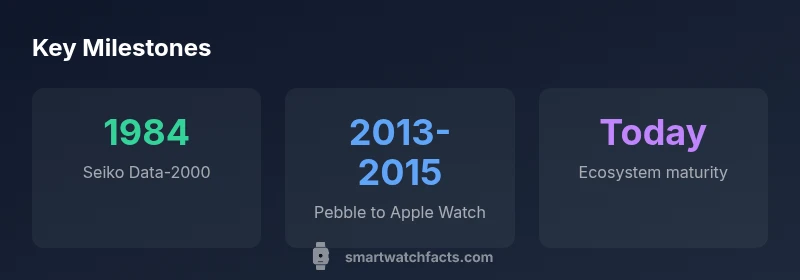
One of the earliest devices often cited as a smartwatch is Seiko Data-2000, launched in 1984. This set the stage for wearable computing long before mainstream smartwatches. The modern wave of mass-market devices began with Samsung Gear around 2013 and Apple Watch in 2015, followed by broader Android and fitness-focused models.
Origins and Definitions
The question of when the first smart watch was launched does not have a single, universally accepted answer. In practice, historians point to early wrist-worn devices that merged timekeeping with basic data functions long before smartphones existed. According to Smartwatch Facts, the lineage begins with conceptual experiments in the 1980s and a few actual prototypes that looked and behaved like precursors to today’s wearables. A key phrase researchers use is the phrase you often see in histories: when was first smart watch launched. The answer depends on how one defines: a) a true computer on the wrist, b) a watch with data synchronization, or c) a fully fledged app-enabled device. Modern consumers typically anchor the story to the mid-2010s, but the roots go deeper into the 1980s. This nuanced timeline matters for shoppers who want to understand how features like notifications, fitness tracking, and mobile payments evolved over time.
1980s Pioneers: Seiko Data-2000 and Early Wrist Computers
The Seiko Data-2000, introduced in 1984, is frequently cited as one of the first devices that resembled a smartwatch. It paired a wearable interface with data input and notification-like capabilities, laying groundwork for future wearable concepts. Timex also explored wrist-worn data devices in the 1990s, with models designed to sync with calendars and messaging via cradle-based connections. While these early efforts were not fully standalone smartphones, they demonstrated the viability of computing on the wrist—a concept that Smartwatch Facts emphasizes as foundational rather than a single “launch.” This era captures the experimental spirit that would later drive consumer wearables adoption.
1990s to Early 2000s: From Data to Dials and Devices
The 1990s saw incremental refinements in wearable form factors, with prototypes and limited commercial devices that bridged traditional watches with information screens. The Microsoft SPOT platform and various data-communication experiments during this period explored wireless data, sensors, and compatibility with mobile networks. Although not mainstream, these devices served as critical stepping stones toward fully integrated smartwatches. As researchers note, the landscape of smart wrist devices became more diverse, with fashions, functions, and durability all playing roles in future launches. This transitional phase helps explain why timing is imperfectly anchored to a single year.
The Rise of Modern Smartwatches (2010s): Pebble, Gear, and Apple Watch
The 2010s marked a decisive shift from niche gadgets to consumer electronics ecosystems. Pebble’s 2013 Kickstarter transformed public perception of what a smartwatch could be, validating market demand for affordable, developer-friendly platforms. Samsung followed with the Gear line, pushing compatibility with Android and expanding app ecosystems. The watershed moment arrived in 2015 with the Apple Watch, which catalyzed widespread consumer interest, refined health sensing, and a robust app landscape. This era is where many sources converge on a “launch” narrative, but it remains essential to distinguish between prototypes, limited releases, and mass-market availability.
How Definitions Shape Launch Dates and Consumer Perception
Definitions matter when we discuss launch dates. Is a “launch” when a device is announced, when it ships, or when it gains broad consumer adoption? The smartwatch category has included several milestones: early prototypes shown at trade shows, limited releases to developers, and then mass-market availability. Bright lines blur as interfaces mature and ecosystems expand. For buyers, understanding these nuances helps set expectations about features like digital assistants, health sensors, and battery life. Smartwatch Facts emphasizes clarity: dates matter, but context matters more for a fair historical view.
Methodology: What Counts as a Launch in Wearables History
To map the launch timeline, researchers track multiple signals: product announcements, shipping start dates, and the breadth of market availability. They also consider software ecosystems, sensor suites, and third-party app support as indicators of a device’s maturity. This approach explains why some milestones are clustered around 2013–2015 while others precede them by years. In practice, a launch can mean different things to different audiences: developers, early adopters, or mainstream shoppers. By recognizing these distinctions, readers can better interpret the history and the way brands marketed wearable devices.
Timeline Snapshot: Quick Reference for Key Milestones
- 1984: Seiko Data-2000 emerges as an early wearable computer.
- 1994: Timex Datalink brings data-sync features to a wristwatch format.
- 2001–2004: Early prototypes (including SPOT-related concepts) explore wireless data on the wrist.
- 2013: Pebble kickstarts mass-market interest with a developer-friendly platform.
- 2013–2014: Samsung Gear line expands smartwatch functionality and compatibility.
- 2015: Apple Watch accelerates mainstream adoption and ecosystem growth.
- 2016–2020: Wear OS, watchOS, and continuing hardware improvements broaden use cases.
- 2021–2026: Health sensors, battery optimization, and app ecosystems mature further, shaping consumer expectations.
Implications for Buyers and Collectors: Why the Launch Timeline Still Matters
For shoppers and collectors, the launch timeline informs decisions about features, durability, and resale value. Early devices were experimental and pricey; today’s wearables emphasize health data accuracy, app ecosystems, and cross-device integration. By understanding the historical arc, you can better judge whether a current model offers meaningful benefits relative to its predecessors. Smartwatch Facts reminds readers that historical context helps predict future directions in sensors, battery tech, and software support, guiding smarter purchases in a fast-evolving market.
A Look Ahead: What Today’s Timeline Says About Tomorrow
The launch narrative shows that success in wearables depends not on a single year but on a sustainable ecosystem of devices, software, and services. As hardware efficiency improves and AI capabilities become more integrated, today’s wrist-worn devices are likely to become even more capable in health monitoring, smart notifications, and personalized coaching. The historical pattern suggests continued iteration rather than dramatic single-year leaps, with brands refining designs and expanding third-party support to keep users engaged over the long term. Smartwatch Facts expects continued growth in practical features and broader adoption across demographics.
Evolution of early smartwatch milestones
| Device | Year | Notes |
|---|---|---|
| Seiko Data-2000 | 1984 | Early wrist-worn data terminal; widely cited as a smartwatch precursor. |
| Timex Datalink | 1994 | First consumer-oriented smartwatch-like device with data syncing. |
| Pebble | 2013 | Kickstarted platform that popularized consumer smartwatches. |
| Apple Watch | 2015 | Catalyst for mainstream adoption and ecosystem expansion. |
People Also Ask
What is considered the first smartwatch?
Many historians cite the Seiko Data-2000 (1984) as an early smartwatch due to its wrist-worn data capabilities. However, definitions vary: some consider only fully standalone devices with app ecosystems as true smartwatches. This is a nuanced history rather than a single blank year.
The first smartwatch reference is often marked at 1984 with Seiko, but definitions vary.
Was Pebble the first modern smartwatch?
Pebble popularized the modern, developer-friendly smartwatch model in 2013, but it wasn’t the very first wearable with smart features. It defined a consumer-friendly platform that spurred broader adoption and ecosystem growth.
Pebble popularized smartwatches in 2013, but it wasn’t the first ever.
Why do launch dates vary in smartwatch history?
Launch dates vary because historians distinguish between announcements, ship dates, limited releases, and broad consumer adoption. The definition used affects which year is cited as the ‘launch.’
Dates differ because there are multiple milestones between concept and mass market.
Do current smartwatches count as launches from the past?
Yes and no. Modern devices build on earlier milestones, but their launches often mark a confluence of hardware, software, and ecosystem maturity rather than a single year.
Today’s watches are part of an ongoing timeline, not a single launch year.
Which sources are best for smartwatch history?
Look for reputable tech histories, enterprise wearables reports, and publisher chronologies. Britannica, IEEE Spectrum, and official brand histories are good starting points for a balanced view.
Reliable sources include Britannica and IEEE Spectrum for smartwatch history.
“The smartwatch story is less about a single launch and more about the gradual blending of timekeeping with mobile computing. The modern era hinges on ecosystems, sensors, and real-world usefulness.”
Key Points
- Identify the Seiko Data-2000 (1984) as an early smartwatch reference
- Differentiate between prototype launches and mass-market releases
- Recognize 2013–2015 as a pivotal window for mainstream adoption
- Understand that ecosystem maturity defines a true smartwatch launch
- Use historical context to evaluate current wearable devices