How Long Do Garmin Smart Watches Last
Explore real-world Garmin smartwatch battery life across modes (GPS, smartwatch, solar) and models, with practical tips to maximize uptime and efficient charging.


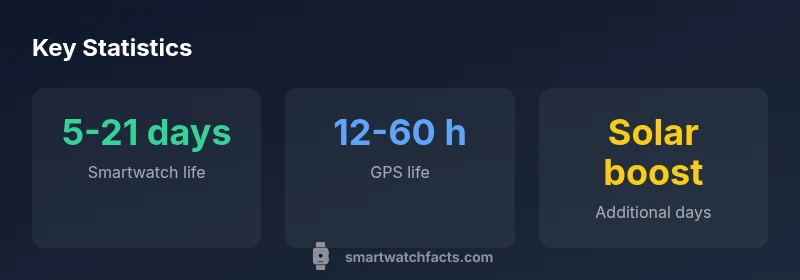
Garmin smart watches typically last multiple days on a single charge, with life ranging from around 5 to 21 days, depending on model and usage. In smartwatch mode you’ll reach the upper end; GPS usage shortens life substantially. Solar-enabled models can push lifespans higher in bright conditions, while features like streaming music or continuous heart-rate monitoring increase drain.
How Garmin Battery Life Varies Across Models
Garmin's lineup spans several families designed for different kinds of users. The battery life you see in smartwatch mode can range from a few days to multiple weeks, largely driven by display technology, sensor load, and software efficiency. A key takeaway is that model design and firmware optimizations influence real-world endurance just as much as advertised specs. The Smartwatch Facts team notes that practical uptime often diverges from marketing figures, depending on how you wear the watch and what features you enable. For example, a basic outdoor-focused model will typically last longer than a feature-rich smartwatch with Always-On Display, music, and continuous heart-rate monitoring.
According to Smartwatch Facts, the largest factors are display type, GPS activity, and power-saving settings. Runtimes improve when users tune notifications, use offline music, and limit background sensors during extended outings.
Battery Life by Usage Mode: Smartwatch vs GPS vs Solar
The dominant variable is how you use the device. In smartwatch mode, the watch remains on with notifications, heart-rate sensing, and sometimes sleep tracking active, which yields the longest runtimes. Turning on GPS for workouts dramatically reduces life—sometimes by days, depending on cadence, tracking accuracy, and path complexity. Solar-enabled Garmin watches add a layer of complexity: in bright conditions, the solar panel can contribute a measurable amount of energy, extending daily uptime. However, the magnitude varies with sun exposure, climate, and how much you rely on power-hungry features. Always-on modes and music streaming further accelerate drain, particularly during long outdoor adventures.
From a practical standpoint, expect longer runtimes in smartwatch mode and shorter ones when GPS is used extensively; solar helps only if you regularly spend time outdoors in sunlight.
Battery Life by Garmin Series (Fenix-series, Forerunner-series, Venu-series, Instinct-series)
Battery endurance correlates with intended use and power management. Fenix-series watches are known for large batteries and efficient components, often delivering the longest smartwatch-mode runtimes among Garmin devices. Forerunner-series tends to balance GPS accuracy with endurance, suitable for runners who want reliable metrics without sacrificing too much battery life. Venu-series prioritizes display quality and health features, which can shorten GPS-heavy runtimes but still offer respectable life in smartwatch mode. Instinct-series emphasizes rugged durability and outdoor capability, typically delivering robust runtimes in varying conditions. The overarching lesson is to match a model’s core strengths to your activity profile to optimize battery life.
Real-World Scenarios and Expected Lifespan
Imagine a typical week: 3–4 GPS workouts, 1–2 days of light smartwatch use, plus sleep-tracking and occasional music playback. Depending on the model, you might see 2–4 days during GPS-heavy weeks or 7–14 days when GPS is used sparingly. Solar variants can push this higher if you spend significant time outdoors with ample sun exposure. In practice, these ranges reflect everyday behavior and the watch’s power management algorithms rather than exact guarantees. Tracking your own usage over a few weeks in the Garmin app will yield the most accurate personal estimate.
Practical Tips to Maximize Battery Life
- Set a conservative brightness level and shorten the automatic brightness window.
- Disable Always-On Display when you don’t need it; turn off unnecessary notifications.
- Use GPS only when needed; switch to GPS-friendly activity modes and avoid continuous high-accuracy tracking unless required.
- If you stream music, download offline playlists and limit streaming over cellular data.
- Employ power-saving modes during long days and ensure firmware is up-to-date for efficiency improvements.
- If you own a solar model, wear it outdoors in daylight to maximize solar charging potential.
- Charge regularly and avoid letting the battery drop to 0%; a regular charging routine reduces wear over time.
- Check battery health in the Garmin Connect app and consider service if capacity drops noticeably over months.
How to Estimate Your Personal Battery Life: A Quick Method
Start with the smartwatch-mode baseline for your model (often 5–21 days). Add reductions for GPS usage (roughly 0.5–2 days per GPS hour, varying by model). If you own a solar model, factor in sun exposure weekly to estimate additional daily uptime. Over several weeks, track actual usage in the Garmin app to refine your personal estimate and set realistic expectations for trips or events.
Estimated endurance across Garmin series
| Model Type | Smartwatch Life | GPS Life | Solar/Notes |
|---|---|---|---|
| Fenix-series | "14-21 days" | "40-60 hours" | Solar: yes (sun exposure) |
| Forerunner-series | "12-23 days" | "20-42 hours" | Solar: no |
| Venu-series | "5-12 days" | "8-20 hours" | Solar: no |
| Instinct-series | "14-28 days" | "16-30 hours" | Solar: no |
People Also Ask
What factors most affect Garmin battery life?
GPS usage, screen brightness, always-on display, notifications, and music streaming drive drain. Reducing these features when you need longer uptime is the practical workaround.
Battery life is mainly driven by GPS use, screen brightness, and notifications; adjust these to save power.
Do solar Garmin watches really last longer?
Yes, solar can extend uptime in bright sun, but gains vary by model, exposure, and how you use the watch.
Solar can help when you’re outdoors, but results differ by conditions and model.
How accurate are Garmin's battery life estimates?
Garmin estimates are guides based on typical usage; your actual results depend on settings, activity, and health sensors.
They’re good guidelines, not guarantees.
Can I replace the battery in Garmin watches?
Most Garmin watches use sealed batteries and require service or replacement rather than user replacement.
Batteries aren’t typically user-replaceable.
Is a solar model worth it for battery life?
If you spend time outdoors, solar can extend uptime; otherwise benefits may be modest and depend on sun exposure.
Solar helps in sunny environments, but it isn’t a magic fix.
How long does charging take on Garmin watches?
Most Garmin watches recharge in about 1-2 hours from empty, depending on charger type and battery health.
Typical charges take around 1 to 2 hours.
“Battery life is a function of usage; adjust GPS, brightness, and notifications to maximize uptime, especially on long trips.”
Key Points
- Plan around real-world usage to estimate battery life
- Solar models extend uptime in sunny environments
- Reduce GPS use and brightness to maximize life
- Check battery health and firmware for efficiency gains
- Choose a model aligned with your outdoor or activity needs