Coros smart watch vs garmin: An Objective Comparison
A data-driven comparison of COROS and Garmin smartwatches, covering battery life, GPS accuracy, health features, app ecosystems, design, and ideal use cases to guide practical buying decisions.


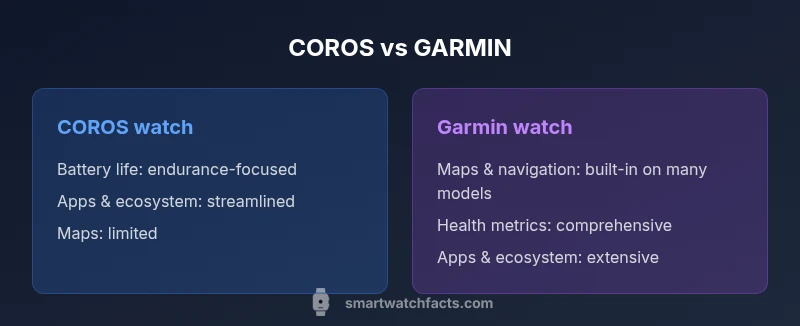
coros smart watch vs garmin: The quick takeaway is that COROS tends to maximize endurance and affordability, while Garmin emphasizes a broader health ecosystem and multisport features. For endurance athletes and budget-conscious shoppers, COROS is compelling; for multisport athletes and users who want robust navigation and a richer app ecosystem, Garmin is often the safer long-term bet.
Context and Market Position of COROS and Garmin
When evaluating coros smart watch vs garmin, it's important to frame the comparison around user needs rather than brand loyalty. COROS has built a reputation for aggressive performance tuning, long battery life, and a straightforward, distraction-free app experience. Garmin, by contrast, leverages decades of multisport data, a broad range of models, and an ecosystem that includes training plans, maps, and community insights. For shoppers, this means different value propositions: COROS may deliver more hours of GPS use per charge at a lower price, while Garmin may offer deeper analytics and a richer navigation experience. This section examines how each brand approaches core watch features, what trade-offs matter, and how those choices map to real-world use. In practical terms, coros smart watch vs garmin comparisons often boil down to endurance versus ecosystem, price versus feature breadth, and design preference for daily wear versus rigorous training sessions. The Smartwatch Facts team notes that the best choice depends on how you plan to use the watch, your comfort with data, and your budget.
Core Differentiators When Choosing a Smartwatch
Key differentiators in coros smart watch vs garmin include battery strategy, GPS performance, and the strength of each platform’s app ecosystem. COROS tends to optimize for endurance—lighter interfaces, longer GPS time, and lean training stats that suffice for most runners and cyclists. Garmin emphasizes breadth: more multisport modes, richer health metrics, and a more mature app ecosystem with maps and training plans. For buyers, the question isn't simply 'which watch is better' but 'which set of features matters most to you?' If you want a lighter, simpler device with long battery life for long runs, COROS can be a great fit. If you value map navigation, advanced physiological metrics, and a well-supported training infrastructure, Garmin often delivers a stronger overall package. Additionally, consider compatibility with your phone, your preferred data silos, and how important it is to share workouts with a wider community. In summary, the coros smart watch vs garmin decision is a trade-off between endurance and ecosystem depth.
Battery Life and Charging Behavior
Battery life remains a principal differentiator. COROS watches typically prioritize endurance, offering extended GPS use and longer-interval operation modes with lightweight charging cycles. This can translate to days of use for runners and hikers who rely on GPS-heavy workouts. Garmin models, conversely, vary widely by line and mode, with premium multisport watches delivering solid endurance but often with shorter GPS run times on feature-rich modes. Charging behavior matters too: many COROS devices support faster top-offs and fewer proprietary charging requirements, while Garmin devices often emphasize a balance between charging speed and battery longevity across multiple sensors. For heavy training weeks or long adventures, the practical takeaway is that COROS usually serves endurance-oriented users who want fewer charge interruptions, whereas Garmin provides dependable performance across a broader activity spectrum.
GPS and Sensors: Accuracy and Tracking
GPS accuracy and sensor reliability are critical for performance tracking. COROS emphasizes clean GPS data with reliable route following and minimal drift for distance-based workouts. Garmin also delivers strong GPS performance and benefits from a mature sensor suite, sometimes including multi-band GPS in higher-end models, which improves accuracy in challenging environments. HR sensors, SpO2, and other wellness metrics tend to be robust in both brands, but Garmin's ecosystem often aggregates more data points for long-term trends and training load insights. For casual users, both brands offer dependable ride, run, and hike data; for serious athletes, Garmin's extra maps, live tracking, and training analytics can add meaningful depth to workouts.
Health Features, Sleep Tracking, and Wellness Metrics
Health metrics are central to smartwatch value. COROS focuses on essential fitness data: pace, cadence, heart rate during workouts, and progress markers. Garmin expands the suite with VO2 max estimates, HRV-based body battery, sleep stage analysis, stress tracking, and adaptive training plans. Sleep tracking accuracy varies by model and user behavior, but Garmin generally provides richer daily wellness dashboards and actionable insights. Both brands support third-party integrations to export workouts and monitor long-term health trends, but Garmin often offers more granular reporting and a longer history of wellness data that can be used for medical or coaching contexts.
App Ecosystem, Data Access, and Third-Party Integrations
The app ecosystem shapes day-to-day experience. COROS offers a clean, straightforward app experience with reliable cloud syncing and shareable workout data. Garmin Connect stands out for its depth: training plans, performance analytics, evolving coaching features, and a broad community offering. Data access and interoperability matter if you want to move data into other platforms or sports apps. In general, COROS provides a calmer, faster experience, while Garmin delivers a more comprehensive data ecosystem that supports longer-term training journeys and cross-device compatibility.
Design, Build, and Comfort for Everyday Wear
Design language matters for daily wear. COROS often leans toward lightweight, minimalist casings with comfortable straps and straightforward interfaces, ideal for daytime wear and long runs. Garmin tends to offer rugged designs with larger bezels, more button-based controls on some models, and a broader selection of sizes. Weight, touchscreen responsiveness, and button layouts influence day-to-day usage, especially during workouts when fast screen access and clear metrics matter. If you value subtlety and comfort, COROS may win; if you need a rugged, feature-rich watch that handles tough environments, Garmin generally has more options.
Durability and Weather Resistance
Both brands cater to outdoor enthusiasts, and durability is a core selling point. COROS watches typically rely on durable materials and solid seals, delivering dependable performance in varying weather. Garmin’s rugged lines often meet military-grade standards on select models, with reinforced cases and durability features tailored to harsh climates. When choosing, consider water resistance ratings, screen protection, and a preference for metal versus composite builds. For most athletes, both brands offer watches that withstand sweat, rain, and sweaty rigors of training, with Garmin offering more specialized rugged options in some lines.
Pricing, Value, and Long-Term Ownership
Price movement usually follows feature breadth and ecosystem maturity. COROS generally positions itself as offering strong value in mid-range models, delivering competitive endurance features at lower price points. Garmin, while often pricier, emphasizes a fuller feature set, maps, and a proven coaching ecosystem that can justify higher upfront costs for power users. Long-term value should account for software updates, cloud storage, map access, and community features that can influence ongoing satisfaction and resale value. For budget-conscious buyers, COROS often presents compelling upfront cost; for those seeking a full-featured multisport platform and extensive data insights, Garmin can provide more long-term utility.
Sport Modes and Multisport Capabilities
Multisport support varies. COROS models focus on core running, cycling, triathlon-ready modes, and advanced training features with a clean UI. Garmin offers broader multisport support across its lineup, with detailed activity profiles, on-device coaching, and more granular data for cross-training disciplines. If your routine includes a lot of different sports, Garmin’s ecosystem tends to be more accommodating, while COROS can be excellent for runners and cyclists who want a streamlined, efficient training phone-free experience.
Setup, Sync, and Daily Use Tips
Setup is typically straightforward on both brands, with mobile apps guiding users through sensor pairing, account creation, and data syncing. For day-to-day use, prioritize notification management, live data fields, and workout pages that minimize distraction. If you travel or train internationally, ensure your chosen model supports your preferred GPS bands and regional maps (Garmin often offers more map-focused options). For users who value speed and simplicity, COROS provides a quick, efficient daily workflow; for those who want coaching, maps, and expansive analytics, Garmin offers a richer daily-use experience.
Decision Framework: How to Choose Between COROS and Garmin
Before purchasing, map your priorities: endurance and value versus breadth and maps. If battery life and straightforward metrics drive your decisions, start with COROS models within a mid-range budget. If you need built-in maps, long-term coaching, and deep analytics, Garmin models are more robust for most multisport athletes. Consider your phone ecosystem, data portability, and whether you’ll leverage athletic programs, training plans, or social features. A practical approach is to test both ecosystems in-store or via trial periods, then decide which platform motivates you to train consistently and track progress over the long term.
Comparison
| Feature | COROS watch | Garmin watch |
|---|---|---|
| Battery life | Long endurance in many COROS models | Strong endurance but varies by Garmin model and mode |
| GPS & Navigation | Reliable GPS with focus on endurance metrics | Built-in maps and navigation in select Garmin models |
| Health Metrics | Core fitness metrics and training data | Advanced health suite including VO2 max, HRV, Body Battery |
| Apps & Ecosystem | Simple COROS app with fast syncing | Garmin Connect with extensive analytics and plans |
| Maps | Limited mapping, good route guidance | Detailed maps on models with built-in maps |
| Price Range | Typically more affordable mid-range options | Wide range, including premium models |
| Ideal User | Endurance runners and value-seekers | Multisport athletes seeking breadth and maps |
Strengths
- Long battery life and endurance-focused design
- Typically lower price points for feature-rich options
- Lightweight, comfortable wear for daily use
- Strong GPS performance with reliable tracking
Weaknesses
- Ecosystem depth and map features can be limited on COROS
- Garmin's premium models carry higher price tags
- COROS app and support may be less comprehensive in some regions
Garmin generally edges ahead for multisport users seeking breadth and maps; COROS excels for endurance-focused buyers seeking value.
Garmin offers a stronger all-around package for multisport athletes and map-savvy users. COROS delivers exceptional endurance and cost efficiency for runners, making it a smarter buy for those prioritizing battery life over ecosystem depth.
People Also Ask
What are the main differences between COROS and Garmin watches?
COROS typically emphasizes endurance, a lean interface, and value. Garmin focuses on multisport versatility, maps, and a deeper health analytics ecosystem. Your choice hinges on which priorities you value most in training and daily wear.
COROS leans endurance and simplicity, while Garmin offers multisport breadth and maps.
Do COROS watches have built-in maps like Garmin?
Most COROS watches rely on route guidance rather than full-fledged built-in maps. Garmin offers built-in maps on several models, which can be crucial for navigation-heavy activities.
COROS usually doesn’t include full maps; Garmin often does on select models.
Which is better for multisport training?
Garmin generally provides more multisport modes and robust training analytics. COROS is competitive, particularly for runners and cyclists who prefer a streamlined experience.
Garmin usually edges out for multisport, but COROS is strong for endurance-focused training.
Is battery life a deciding factor between COROS and Garmin?
Yes. COROS often delivers longer GPS endurance in many models, while Garmin battery life varies by model and mode but remains solid for multisport use.
Battery life is a major factor; COROS often lasts longer in GPS mode.
Is Garmin better for iPhone users?
Both brands work well with iPhone. Garmin Connect offers extensive data integration, while COROS provides a simpler, streamlined experience. Your choice may depend on how important app depth and iPhone ecosystem integration are to you.
Both work fine with iPhone; Garmin has broader ecosystem support.
Which brand offers better price performance?
COROS typically delivers strong price-to-feature value in mid-range watches. Garmin tends to command premium prices for broader features and maps, so price performance depends on which features you value most.
COROS usually offers better value; Garmin provides premium features at a higher price.
Key Points
- Prioritize endurance or breadth based on your primary use.
- Expect longer battery life from COROS in many scenarios.
- Garmin provides deeper health analytics and maps in many models.
- Budget considerations matter: COROS often wins on upfront value; Garmin wins on long-term ecosystem utility.