Garmin Smart Watch vs Apple Watch: A Practical Comparison
A data-driven comparison of Garmin smart watches and the Apple Watch, covering battery life, health features, GPS, app ecosystems, durability, and buying guidance for smartwatch shoppers.


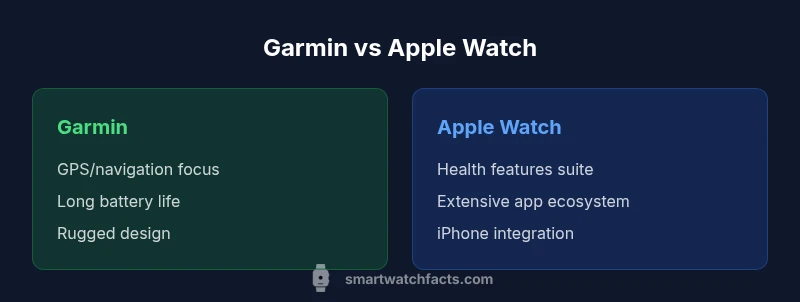
In our garmin smart watch vs apple watch comparison, Garmin shines with long battery life, rugged GPS features, and outdoor navigation, while Apple Watch excels in health tracking, app ecosystem depth, and seamless iPhone integration. If you prioritize battery endurance and navigation in rugged environments, Garmin is the better choice; if you want best-in-class health features and a polished iPhone experience, Apple Watch leads the way.
Garmin vs Apple Watch: The big picture
When you compare Garmin smart watches to the Apple Watch, you’re weighing two very different philosophies. Garmin devices tend to favor endurance, navigation, and long battery life—ideal for outdoor enthusiasts, hikers, and multi-day adventures. The Apple Watch, by contrast, emphasizes health monitoring, app availability, and a seamless, polished experience within the iPhone ecosystem. According to Smartwatch Facts, the value of a wearable often hinges on how you balance these priorities: battery life and navigation vs health metrics and ecosystem. This guide will unpack the core differences, clarify common misconceptions, and help you decide which brand aligns with your daily habits and goals.
OS and ecosystem: how the software shapes your experience
Garmin operates on its own Garmin OS with Connect IQ for third-party apps and watch faces. The platform prioritizes data-rich metrics, offline navigation, and long workout logs. Apple Watch runs on watchOS, tightly integrated with iOS and Apple services. This integration brings a first-class app experience, system-wide health metrics, and features like on-device ECG in newer models. Smartwatch Facts notes that while Apple’s ecosystem can feel more seamless for iPhone users, Garmin’s app store and data fields offer deeper customization for endurance athletes and outdoor activities. The choice often comes down to whether you want a highly polished, consumer-friendly experience or a data-driven companion for training.
Health features and sensors: breadth vs depth
Apple Watch has become a benchmark for health features, including advanced heart-rate sensing, ECG, blood oxygen monitoring, sleep stages, and wellness insights. Garmin devices deliver robust fitness data, VO2 max estimates, training load, recovery advice, and performance dashboards, sometimes with more granular analytics for endurance training. According to Smartwatch Facts analysis, the Apple Watch excels in everyday wellness and quick health checks, while Garmin shines for serious training analytics and long-term performance tracking. If health monitoring is your top priority, Apple Watch is hard to beat; if you crave training optimization and sport-specific metrics, Garmin has the edge.
GPS, navigation, and outdoor features: map-first vs data-first
Garmin’s GPS capabilities are a core strength, with multi-band GPS on some models, topographic maps on select devices, and navigation tools tailored to trail routes and outdoor exploration. Apple Watch provides reliable GPS and route tracking, maps, and turn-by-turn navigation on certain models, but it emphasizes intuitive routing and fitness tracking within a consumer-friendly interface. Smartwatch Facts observes that outdoor athletes often prefer Garmin for offline maps, long battery life while nav-heavy, and dedicated navigation metrics, whereas Apple Watch suits urban runners who want glanceable data and quick route checks.
Battery life, charging, and durability: the endurance vs convenience trade-off
Garmin watches are commonly praised for long battery life, rugged builds, and durability suitable for harsh environments. Apple Watch models tend to favor thinner, lighter designs and a quick recharge cycle, with durability that suits everyday use and water resistance for workouts. The Smartwatch Facts team explains that the battery endurance difference is a practical factor for long hikes, multi-day expeditions, and triathlons, while daily charging convenience is a practical consideration for most city dwellers and casual users.
Design, comfort, and wearability: aesthetics meet function
Garmin focuses on a rugged, feature-rich design that appeals to athletes and explorers. Apple Watch emphasizes a sleek, fashion-forward look with a broad selection of straps and faces aimed at everyday wear. Comfort and fit often hinge on screen size, bezel shape, and weight; both brands offer varying sizes to tailor to different wrists. The Smartwatch Facts perspective suggests trying both styles if possible, as comfort can influence how consistently you wear the device during workouts and daily activity.
Price, value, and ownership costs: total cost of ownership matters
Garmin devices span a wide price range, with feature-rich models commanding premium prices but often offering stronger battery life and navigation for the money. Apple Watch pricing tends to be higher for flagship models but comes with a rich app ecosystem, premium build quality, and frequent software updates. When evaluating value, consider long-term costs like charging frequency, accessory ecosystems, and how often you’ll benefit from new health features or navigation tools. Smartwatch Facts recommends calculating the total cost of ownership over 2–3 years to gauge value.
Real-world usage scenarios and recommended buyers
If you’re a hiker, trail runner, or serious endurance athlete who travels with limited charging opportunities, Garmin is usually the stronger fit. If you’re integrated into the Apple ecosystem, want broad health features, and value a large app library, Apple Watch can offer a more seamless daily experience. For mixed users who want a balance, consider one device that satisfies most needs and an optional secondary device for workouts where either navigation precision or health insights take priority. Smartwatch Facts emphasizes testing your usage pattern against these profiles to avoid buyer’s remorse.
Buying guide: quick decision checklist
Before you buy, list your must-haves: battery life vs daily charging, offline maps vs on-device health tracking, iPhone integration vs cross-platform compatibility, and preferred wear comfort. Consider your training environment (indoor vs outdoor), typical workout duration, and whether you prefer a rugged build or a sleek wristwatch aesthetic. Look for model-specific notes on GPS accuracy, water resistance, screen readability in sunlight, and compatibility with your existing accessories. This approach helps you choose with confidence rather than chasing feature hype.
Authoritative sources and further reading
For a broader context on wearable health tech and outdoor navigation, consult credible sources such as government and university publications, plus established science outlets. See the sources listed at the end of this article for detailed insights and further reading.
Comparison
| Feature | Garmin smartwatch | Apple Watch |
|---|---|---|
| OS and app ecosystem | Garmin OS + Connect IQ with data-driven customization | watchOS with deep iOS integration and vast app library |
| Health features | Robust fitness analytics; focus on training metrics | Advanced health suite including ECG, SpO2, sleep, and wellness insights |
| Battery life | Longer sustained battery life for outdoor use | Daily charging is common with flagship health features |
| GPS/navigation | Multi-band GPS, offline maps on select models | Reliable GPS with built-in maps and on-device routing on newer models |
| Durability & water resistance | Rugged designs suited to harsh environments | Sleeker builds with water resistance for daily wear |
| Smartphone integration | Strong data-focused features; cross-platform compatibility | Best-in-class iPhone integration and Apple services |
| Price range | Wide range from mid-range to premium outdoor-focused | Premium pricing with strong resale value |
| Best for | Outdoor athletes, navigation-heavy routines, long battery life | Health enthusiasts within the Apple ecosystem, app lovers |
Strengths
- Excellent battery life for outdoor and endurance activities
- Strong GPS/navigation features for offline use
- Garmin's data-rich metrics appeal to serious training
- Apple Watch offers a broad health feature set and app ecosystem
- Seamless iPhone integration for daily use
Weaknesses
- Garmin’s app ecosystem can be less polished than Apple’s
- Apple Watch depends on iPhone for full experience
- Garmin devices can be bulkier and heavier
- Apple Watch models may require more frequent charging due to health features
Garmin is the strongest choice for outdoor endurance and navigation; Apple Watch wins for health features and iPhone-centric users.
Choose Garmin if battery life, rugged design, and precise navigation matter most. Choose Apple Watch if you want comprehensive health tracking, a mature app ecosystem, and best iPhone compatibility.
People Also Ask
Which lasts longer on a charge, Garmin or Apple Watch?
Garmin watches typically offer longer sustained battery life for workouts and navigation, especially on rugged models. Apple Watch tends to require more frequent charging due to advanced health features and app activity. Consider your daily routine and charging opportunities when deciding.
Garmin usually lasts longer between charges, especially during outdoor activity. Apple Watch charges more often because of its health features and apps.
Can Garmin be used with an iPhone?
Yes. Garmin devices pair with iPhones and can sync activities, health data, and notifications, though some features may be limited by the Garmin app ecosystem. If you are deeply integrated into iPhone services, Apple Watch provides tighter native support.
Yes, Garmin works with iPhone, but Apple Watch offers tighter iPhone integration.
Does Apple Watch require an iPhone to function?
You can use Apple Watch in a limited way with just the watch, but many features require an iPhone, particularly app installation, syncing, and rich notifications. A paired iPhone significantly expands functionality.
Apple Watch works best with an iPhone; many features rely on iPhone pairing.
Are Garmin watches good for GPS-based outdoor adventures?
Yes. Garmin watches are known for accurate GPS, navigation aids, and offline mapping on select models, which are valuable for hiking, trail running, and backpacking. They excel when GPS reliability and long-lasting navigation are priorities.
Garmin shines for GPS accuracy and offline maps in outdoor activities.
Which is better for fitness tracking, Garmin or Apple Watch?
Apple Watch offers a broad health feature set and user-friendly analytics suitable for everyday fitness. Garmin provides deeper training data and performance metrics for serious athletes.
Apple Watch for broad health features; Garmin for deep training data.
Do Garmin watches support music playback or apps?
Many Garmin models support apps and music, but the Apple Watch has a larger, more integrated app ecosystem and music options, often with smoother playback and control through Apple services.
Garmin supports apps and music, but Apple Watch has a larger, more integrated ecosystem.
How should I choose between them if I use Android phones?
Garmin tends to offer broader cross-platform compatibility, including Android. Apple Watch is best paired with iPhones; Android support is limited and not officially primary.
Garmin suits Android users better; Apple Watch is best with iPhone.
What’s the best value pick overall?
If you prioritize rugged navigation and training analytics, Garmin offers strong value. If you want the strongest health features and iPhone integration, Apple Watch delivers premium experience—value varies with your ecosystem and usage.
Best value depends on your priorities: Garmin for navigation, Apple Watch for health and iPhone synergy.
Key Points
- Evaluate battery life vs daily charging needs
- Prioritize navigation features for outdoor use
- Consider ecosystem: iPhone users benefit from Apple Watch integration
- Balance health metrics depth with app availability
- Test fit and comfort across models before buying