Casio Smart Watch vs Garmin: A Practical Comparison
Explore a practical casio smart watch vs garmin comparison to understand design, durability, GPS, battery life, and value for athletes and casual users.


Here's a quick take on the casio smart watch vs garmin: Garmin devices typically offer advanced GPS, multisport metrics, and robust navigation features ideal for runners and hikers. Casio watches shine in rugged durability, retro style, and affordability for daily wear. The best pick depends on whether your priority is athletic performance or durable, budget-friendly daily use.
Context and Core Differentiators
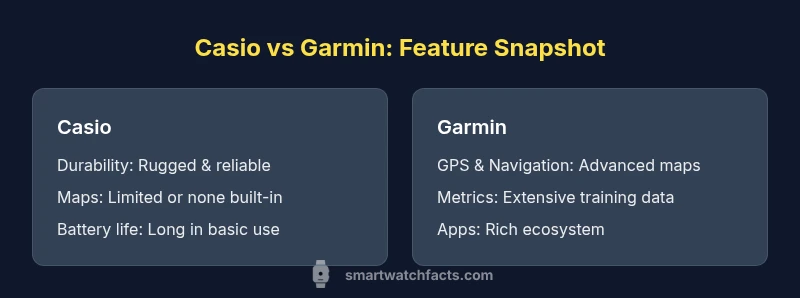
In the casio smart watch vs garmin comparison, user needs vary widely. According to Smartwatch Facts, shoppers are often torn between rugged durability and advanced sport metrics. Garmin devices typically excel in GPS accuracy, multisport tracking, and navigation capabilities, making them strong choices for runners, cyclists, and outdoor enthusiasts. Casio watches lean toward rugged durability, straightforward timekeeping, and approachable price points, appealing to daily wearers who value resilience and low-maintenance devices. This contrast frames a simple decision matrix: if your priority is athletic performance and detailed maps, Garmin has the edge; if you want a proven, tough, budget-friendly wearable for everyday use, Casio is hard to beat. The casio smart watch vs garmin question really comes down to use-case alignment rather than brand loyalty. Start by listing your top three activities, your tolerance for price, and whether you need maps or just timekeeping and notifications. With these guardrails, you’ll converge on a choice that’s practical rather than flashy. The rest of this guide expands on these ideas with concrete criteria you can test in real life.
Design Philosophy and Build Quality
Casio’s design philosophy centers on ruggedness, simplicity, and long-term reliability. The rugged timepiece heritage—embodied by lines known for shock resistance and water resistance—translates into watches that can handle rough handling and diverse environments. The display tends to prioritize legibility in bright light, with sturdy bezels and easily replaceable bands. Garmin adopts a different ethos: fitness-forward, expedition-ready, and performance-oriented. Depending on the model, you get metal cases, reinforced bezels, and screens designed for outdoor use. Garmin builds often emphasize IP ratings and MIL-STD-inspired durability, but with a heavier software footprint that supports training data and navigation. When you carry two options side by side, Casio stands out for robustness and maintenance simplicity, while Garmin excels in mission-critical sensors, crisp task-focused interfaces, and a more polished navigation experience. For daily wear, Casio’s lighter weight and lower profile are appealing; for serious outdoor activity, Garmin’s rugged, feature-rich builds justify the cost.
GPS, Maps, and Navigation
Navigation capability is a central differentiator between these brands. Garmin’s GPS-focused lineup delivers advanced satellite support, multi-band options where available, and in many models, built-in topographic maps and turn-by-turn navigation. The result is a powerful tool for trail running, hiking, cycling, and backcountry exploration. Casio’s navigation features tend to be more restrained and geared toward essential location awareness rather than in-depth maps. While some Casio models offer basic route planning or smartphone-based guidance, they generally rely on pairing with a phone for enhanced navigation. In the casio smart watch vs garmin comparison, Garmin’s maps and navigation present substantial value for athletes and explorers, whereas Casio prioritizes simplicity and reliability when a phone isn’t handy or you don’t need mapped routes.
Health, Fitness, and Sensor Suite
Garmin’s health and fitness suite is expansive. Expect heart-rate monitoring, VO2 max estimation, training load metrics, recovery time, and a broad set of sport profiles. The data you collect can feed into training plans and performance reviews, making Garmin an attractive choice for serious athletes. Casio typically covers essential health tracking—steps, occasional heart-rate sensing, and activity reminders—without the depth of analytics found in Garmin devices. If you seek coaching-style insights and advanced metrics, Garmin has a clear edge; if you want straightforward activity tracking and dependable daily wear, Casio keeps things simple and affordable. The contrast highlights how each brand channels its strengths toward different user personas.
Battery Life and Charging Efficiency
Battery life is often the most visible differentiator in daily use. Casio watches tend to excel in long battery life when advanced sensor use is limited, and they usually charge quickly and simply. In contrast, Garmin devices can offer longer life in basic modes but shorten substantially when GPS and continuous heart-rate monitoring are active. Real-world usage varies with screen brightness, GPS frequency, and notification load. For casual wearers who want weeks of timekeeping without frequent charging, Casio provides a compelling value. For athletes who rely on continuous GPS and training metrics, Garmin’s battery life under load is a trade-off worth understanding, since longer endurance may require careful feature management and charging routines.
Software, Apps, and Ecosystems
The software ecosystems for these brands reflect their core audiences. Garmin’s platform centers on the Garmin Connect app and a thriving third-party app marketplace, with robust data export options and community-driven features. Casio’s software approach emphasizes reliability, offline capability, and compatibility with mainstream smartphones, with a growing but smaller app ecosystem. If you value data-rich analysis, guided workouts, and social sharing, Garmin’s ecosystem is more compelling. If you want a straightforward companion that works well with most phones and emphasizes resilience and low maintenance, Casio’s software experience is attractive. Both brands support standard connectivity like Bluetooth, but the depth of smartwatch apps and integrations is clearly greater on Garmin.
Price, Value, and Ownership Costs
Price remains a practical determinant in many purchasing decisions. Casio watches generally offer more affordable entry points and longer practical lifespans, especially for users who don’t require extensive sport metrics or maps. Garmin devices can be pricier, reflecting the richer feature set and more advanced sensors. The total cost of ownership should factor in not just the sticker price but also subscription costs for premium services, if any, and the value equation for your use-case. If you prioritize budget and durability for everyday wear, Casio presents strong value. If you demand advanced training analytics and reliable navigation for serious athletes, Garmin’s higher upfront cost can be justified by the depth of data and features.
Real-World Scenarios and Use Cases
Consider typical use cases to guide your choice. A hiker who wants reliable timekeeping, basic navigation, and rugged durability might favor Casio for its robust build and low maintenance. A marathon trainer who relies on precise GPS tracking, pacing metrics, and route planning will likely lean toward Garmin for the richer data ecosystem. Night shifts, travel, or environments where charging is a concern may tilt the decision toward Casio, whereas an athlete planning training cycles, VO2 max monitoring, and recovery analytics will find Garmin’s feature set more aligned with goals. The casio smart watch vs garmin comparison thus becomes a practical exercise in matching day-to-day reality to device strengths.
Common Pitfalls and How to Decide
Beware feature overload: many buyers chase every new capability and end up with a device that’s overkill or hard to use. The smarter path is to outline three daily tasks you want to accomplish with your watch (timekeeping, activity tracking, navigation) and test how each brand handles those tasks in real life. Budget constraints are real, so don’t overlook warranty terms, repair ease, and availability of local service when assessing value. Finally, confirm ecosystem compatibility with your smartphone and preferred apps, since that choice often dictates ongoing satisfaction more than raw feature counts.
Quick Decision Framework
To decide quickly, map your priorities to three categories: sport performance (GPS accuracy, training metrics, maps), durability (build quality, water resistance, shock tolerance), and budget (upfront cost, ongoing costs, and maintenance). If GPS, maps, and training analytics are your top priorities, Garmin is the recommended path. If ruggedness, affordability, and minimal maintenance matter most, Casio is the pragmatic choice. Always sanity-check with a hands-on test: try navigation, track a short run, and verify how notifications behave during typical daily wear.
Comparison
| Feature | Casio | Garmin |
|---|---|---|
| GPS & Navigation | Casio: basic GPS with limited mapping | Garmin: advanced GPS with maps and turn-by-turn guidance |
| Durability & Build | Casio: rugged, shock-resistant, reliable for daily wear | Garmin: rugged with MIL-STD-like durability and weather resistance |
| Health & Fitness Metrics | Casio: essential activity tracking | Garmin: extensive metrics (HR, VO2 max, training load) |
| Apps & Ecosystem | Casio: solid smartphone integration, growing but smaller app set | Garmin: mature ecosystem with Garmin Connect and third-party apps |
| Battery Life (Smart features) | Casio: long life with limited sensors active | Garmin: variable; strong endurance in basic mode, shorter with GPS active |
| Price Range | Casio: usually lower upfront cost | Garmin: higher upfront cost but richer feature set |
| Best For | Casio: budget-conscious daily wear with toughness | Garmin: athletes and outdoor enthusiasts needing data and maps |
Strengths
- Casio offers rugged durability and budget-friendly options
- Garmin provides comprehensive fitness metrics and robust maps
- Good app ecosystems and software support for Garmin
- Simple maintenance and long battery life for Casio in basic use
Weaknesses
- Casio may lack advanced training analytics and mapped navigation
- Garmin devices can be expensive for casual users
- Maps and navigation on Casio are limited compared with Garmin
Garmin edges Casio for athletic training and navigation; Casio wins on durability and affordability
Choose Garmin if you prioritize GPS accuracy, training insights, and maps. Choose Casio if you want rugged wearability, simplicity, and lower cost.
People Also Ask
Which watch offers the best GPS tracking, Casio or Garmin?
Garmin generally offers more advanced GPS tracking and broader satellite support, making it the preferred choice for serious athletes. Casio provides reliable basic GPS suitable for everyday use, with less emphasis on multi-sport metrics.
Garmin is typically the better option for precise GPS tracking and training data, while Casio covers essential GPS needs with rugged everyday wear in mind.
Are Casio smartwatches compatible with iPhone and Android?
Casio smartwatches are designed to work with both major mobile platforms, though some features may run best on one platform depending on model. Expect core timekeeping, notifications, and basic fitness tracking to sync reliably.
Casio watches work with both iPhone and Android, though some advanced features may vary by platform.
Do Casio watches have built-in maps or navigation?
Most Casio smartwatches do not include full-fledged built-in maps; navigation is typically smartphone-based or relies on simple location features. Garmin, in contrast, often provides detailed maps and turn-by-turn guidance.
Casio typically lacks detailed built-in maps; Garmin usually offers more advanced navigation options.
Is Garmin better for multisport training?
Yes. Garmin's lineup is designed with multisport tracking in mind, offering diverse sport profiles, advanced metrics, and training analytics that appeal to athletes and coaches.
Garmin is generally better for multisport training due to its extensive metrics and sport profiles.
How does battery life compare between Casio and Garmin?
Casio often delivers longer basic battery life with fewer power-intensive features, while Garmin’s endurance varies with GPS usage and sensor activity. Conservation modes can extend both devices when needed.
Casio tends to last longer in simple use, Garmin varies with GPS and sensors; both can last longer with power-saving modes.
Which is more affordable for casual users?
Casio usually offers more affordable entry models, appealing to budget-conscious buyers. Garmin tends to be pricier, reflecting its richer feature set and analytics.
Casio is typically the more affordable option for casual users; Garmin is pricier but packs more features.
Key Points
- Define your primary use-case: athletics vs durability
- Garmin excels in GPS, metrics, and maps
- Casio delivers rugged durability at a lower price
- Consider your app ecosystem and data needs
- Test both in real-life scenarios before buying