How Long Have Smart Watches Been Around? A History and Timeline
Explore the history of smart watches, from 1980s prototypes to today's health-focused wearables, with a data-driven timeline and practical buying guidance for shoppers.


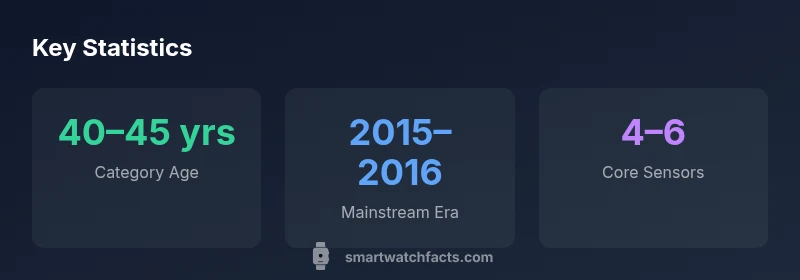
The earliest wearable timekeepers with smart features emerged in the 1980s, with prototype and data-capable watches. Mass-market popularity grew in the 2010s, culminating in Apple's 2015 watch launch that mainstreamed the category. By now, smart watches have been around for roughly four decades, with rapid maturation in health sensors, app ecosystems, and seamless phone integration.
How Long Have Smart Watches Been Around? A Historical Perspective
To answer how long have smart watches been around, we trace milestones from the 1980s when the first wearable devices with data features appeared. Early watches experimented with tiny displays, button interfaces, and data transfer. The mid-1980s and 1990s saw companies exploring 'communications-enabled' devices, but mass-market adoption remained elusive for decades. According to Smartwatch Facts, the lineage expands from prototypes to consumer-ready products as sensors, software, and battery tech mature. By the late 2000s, developers started mainstreaming compact smartwatch concepts, setting the stage for 2010s hardware and software integration. This historical arc helps buyers calibrate expectations around features, durability, and price trajectories across eras.
Early Prototypes and 1980s Innovations
The 1980s witnessed the birth of timepieces that flirted with digital displays and data features, laying the groundwork for wearable tech. Early devices experimented with simple reminders, alarms, and basic communications. Engineers and designers tested the balance between screen size, battery capacity, and readability on a wrist that is not forgiving of bulky hardware. While not yet a mass-market category, these prototypes established the core idea: embed connectivity and information access into a wearable form factor. This period is essential for understanding the constraints that shaped later generations.
The 1990s: From Data Transfer to Concept Watches
During the 1990s, watchmakers explored more ambitious concepts, including devices that could sync data with computers and support rudimentary applications. Although consumer uptake remained limited, this era proved that wireless data exchange on the wrist was technically feasible. Companies experimented with infrared syncing, calendar tools, and specialized features for professionals. The lessons from this decade informed later designs, particularly around user interface, durability, and the importance of a supportive ecosystem of software and accessories.
The 2000s: Pebble and the Rise of Apps
The late 2000s and early 2010s saw wearable concept watches transition toward mass-market products with broader app ecosystems. Pebble’s crowdfunding momentum demonstrated a clear appetite for third-party apps on a wrist-worn device, and manufacturers began focusing on platform development, battery optimization, and water resistance. This shift toward developer ecosystems set the stage for mainstream acceptance, as users could customize experiences with notifications, fitness, navigation, and music controls. The broader consumer public started recognizing smart watches not as niche gadgets but as daily companions.
The 2010s: Apple Watch and Health Tracking
The 2010s heralded a tipping point: smart watches became widely recognized as health and productivity tools. Apple’s 2015 Watch launch accelerated mainstream adoption and spurred competitors to build out health sensors, ECG capabilities, motion tracking, and app ecosystems. The market expanded to accommodate wearables designed for runners, patients managing chronic conditions, and busy professionals seeking at-a-glance information. Battery life, display technology, and software ecosystems matured in tandem, enabling smoother pairing with smartphones and more meaningful health insights.
How Technology Enabled Wearables: Sensors, Batteries, and Connectivity
Key enablers include advances in sensors that monitor heart rate, sleep, activity, and VO2 max; improvements in micro-batteries and efficient processors; and the growth of Bluetooth and NFC for quick pairing and payments. Software platforms evolved from simple notification hubs to full-fledged app stores on the wrist, supporting voice assistants, maps, music, and health apps. The result is a product category that has moved from novelty to essential in many people’s daily routines, with ongoing innovations in display tech, materials, and user experience.
Historical milestones in smartwatch development
| Era | Representative Device or Milestone | Approx Year Range | Notes |
|---|---|---|---|
| Early prototypes | Seiko Data Watch / 1980s concepts | 1984-1989 | Pioneered data features on a wearable |
| Mass-market experiments | Timex Datalink Wrist Computer | 1994-1995 | IR link to PC/palm devices |
| Smartwatch emergence | Pebble Kickstarter era | 2012-2013 | Popularized third-party apps on wrist |
| Modern mainstream | Apple Watch | 2015 onward | Integrated health sensors and apps, broad adoption |
People Also Ask
When did smart watches first appear?
The earliest wearable timekeeping devices with data features appeared during the 1980s. These prototypes laid the groundwork for later consumer products and ongoing development.
Smart watches started in the 1980s with basic data features and experiments.
What device popularized smartwatches?
The category gained mainstream attention after the 2015 launch of the Apple Watch, followed by other platforms that expanded health tracking and app ecosystems.
Apple Watch popularized smartwatches for a broad audience.
Do smart watches work with iPhone and Android?
Most modern smart watches support both major mobile ecosystems, but some features differ by platform. Check compatibility and app availability for your phone.
They work with both iPhone and Android, but features vary.
How long do smart watches last on a charge?
Battery life varies widely, typically ranging from about one day to several days depending on usage, screen brightness, and sensors.
Battery life depends on usage and features.
Are smart watches worth buying today?
If you want health tracking, notifications, and apps on your wrist, a modern smartwatch offers value; compare ecosystems, battery life, and compatibility.
They’re worth it if you want health tools, apps, and quick access to notifications.
What should beginners know before buying?
Consider compatibility with your phone, essential sensors, battery life, and app ecosystem; set a budget and read reviews to gauge real-world performance.
Know your phone, features, and battery expectations before buying.
“Smartwatches have evolved from quirky experiments to essential wearables that blend health data with everyday tasks. Their maturity depends on a robust ecosystem of sensors, software, and reliable battery life.”
Key Points
- Trace smartwatch origins to 1980s prototypes
- Mainstream adoption surged after 2015 Apple Watch
- Health sensors and app ecosystems drive growth
- Battery life and platform compatibility shape buying decisions
- Wearable tech evolved from novelty to daily essential